CANA: A Reflection On Family Life

Status

CANA: A Reflection on Family Life

Taken from the Homily given at the funeral of Fiona Perrem, Nazareth Community. With her husband Peter she guided and supported engaged and married couples for more than 40 years. She died suddenly on October 19, 2015. May she rest in peace.

marriageThat the Wedding at Cana takes place on the third day is very significant because it alludes to the day on which Jesus rose from the dead and it points us all, and especially the married couple, in the direction of the resurrection. It is an invitation to new life, to the joy that flows from Jesus himself, the joy of the Holy Trinity.

A couple who are married in the Lord become one body, one Icon of God, a window giving us a glimpse into God; one revelation of who God is and they live the priesthood of Christ in a way that is not lived by the ministerial priesthood – their love for each other is the supreme image of Christ’s love for the Church.

In giving birth to children they reflect the life-giving priesthood of God the Father. A Christian family in turn becomes an Icon and reflection of the family of the most Holy Trinity.

Marriage and family offer us the various expressions of the One Love of God – espousal, fatherhood, motherhood and the childhood – each of which is found in Sacred Scripture.

The Hidden life of the family of Nazareth is seen by St. Vincent Pallotti as one of the most precious aspects of the life of Jesus. The inner family life that is private and not public, a hidden interior life that feeds all that we are and do when we go out the door of our home to school, to work, to play and to minister. What goes on in the privacy of the home, especially a Christian home is very sacred.

Pope Francis in his homily at the conclusion of the Synod on the Family points out that faith cannot be scheduled. Family life, human life cannot be scheduled in the way that we often want or expect it to be. The thrust and tumble, agony and joy, the mess and the tidying, the unpredictability of our home all contribute to its sacredness. God is in the midst of it all with us.

family-dinnerIn a special way the family table is sacred. I love going to visit families where there are children, to sit at table with them and go with the flow of a child’s natural, God-given way of being. It is certainly an image of what we will experience at heavenly banquet – the abundance spoken of in Isaiah, the experience of salvation, the wiping away of every tear and the consolation of every sorrow. The vibrancy and love of parents and children sitting down together is an Icon of the table of the Holy Trinity.

The marriage feast of Cana is a great expression of the table of the Lord in the Eucharist, table of the Word and sacrament, the source of all grace. It is a cenacle discipleship that has Jesus in all His fullness as its centre; a discipleship that includes the central role of the motherhood of Mary who, in the mystery of Divine Providence, is able to bring forward the hour that has not yet come. 

It is a mystery which tells us that, in the compassionate gaze of God, the need of the human person, the needs of this one married couple somehow take precedence over the “hour” of God himself. In the life of Jesus everything happens at the proper “hour”, it is the time of fulfilment. Cana reveals the parental love, especially the maternal love that always puts the needs of the child before oneself.

We run out of wine, the joy runs out of our lives and we are left empty like the earthen jars, an emptiness that expresses something of the great longing of the human heart, an emptiness waiting to be filled.

On the word of Jesus each is filled with twenty, thirty gallons of water – an abundance. But water is not what is missing at the wedding, no matter how abundant it is. The wedding needs wine and they are given an abundance of it and not just any wine but better wine. The best!

CANAAnd of course Jesus is not just giving new and better wine. He is giving the new life of the Spirit, the transforming life of the Spirit, the transformation that is needed in each particular, unique situation. This is the ‘Cana’ to which every marriage is invited, every family and every solitary person.

There is a sign that Jesus seeks to work in our lives and, if we let Him, then we will see His glory in the ordinary as well as in the miraculous. And by it our faith is strengthened and in believing we are set free.

Remembering Sr Liesel Caspar sac by Sr. Christine Bohr sac

Status

lieselMaria Elisabeth Caspar was born on July 7th 1918 in Berschweiler, diocese of Trier, Germany. She was called Liesel, a short form of her name Elisabeth. Later, in Peru, she was called Isabel – the Spanish form of her name. 

Until 1930 she attended the local Elementary School and then, for four years, the Grammar School in Saarlouis. Liesel grew up in a deeply religious family. Her own sister was also a Pallottine Missionary Sister of the English Province. Her father, an upright and loyal catholic and headmaster of a school, underwent considerable suffering during the Nazi period. 

Liesel felt drawn to missionary life early on. In 1934 she joined the mission school of the Pallottine Sisters in Limburg, and shortly afterwards was sent to the Convent High School, Rochdale, England. She passed her London Matriculation Exam in 1938 and, on October 20th of the same year began her postulancy in Limburg, Germany. On August 16th 1939 she became a novice. She took her first vows on August 17th 1941 and her final ones on August 15th 1947. 

Like so many young professed Sisters at the time, she had to help nurse the sick in the hospital that had been established in the mission house of the Pallottines in Limburg. Here she obtained her Nursing Certificate in 1945. After its closure in 1947 Sr Liesel helped in the office of the Sisters’ motherhouse Marienborn, until she joined the staff of their children’s home in Facit, England. When in 1952 staff and children moved to Pallotti Hall, she was transferred there. 

In 1956 Sr Liesel returned to Limburg, Germany and soon afterwards was sent to the mission in British Honduras, now Belize. At the time her health deteriorated and in 1963 she had to return to Limburg. A few years later she returned to England. 

During her time in England Sr Liesel was able and willing to turn her hand to various ministries. The Pallottines remember her with fondness, for she helped in their college in Thurles, Ireland, and in the Provincial House in Golders Green, London. She was also one of the pioneers who helped get the Westminster Pastoral Centre at London Colney into some form of habitable state. 

One of her happiest periods was the time spent in the mission field of Peru. In 1977 she willingly agreed to help a missionary team from the Diocese of Leeds. One of the Sisters of Mercy who worked there fell ill and Sr Liesel “temporarily” took her place. On 23rd of December she arrived in Huambo in the Diocese of Chachapoyas in the Amazonas region. 

At first Sr Liesel worked in this isolated and poor area in the Andes. She writes of the village: “It could be a replica of Nazareth or Bethlehem with its living quarters and children, donkeys and horses, with its rough streets and insanitary conditions.” Of her first Christmas in Peru she says: “Christmas is everywhere, also in Huambo. Tonight I shall experience it quite differently. He became poor for the poor, and lived with the poor. It makes me very happy to share some of that poverty with Him in order to help these people find happiness in Him. They are all Catholics of a sort, but full of ignorance and superstitions, helpless and hopeless, because they can’t believe that they can improve things with God’s help and their own efforts. Yet they are friendly, open and affectionate and welcomed me like a miracle. May I not disappoint them.” 

She worked very hard in Huambo. Often they had to ride out on donkeys or horses to reach isolated areas where the sick and lonely were waiting for Holy Communion, where children had to be baptised and where the poor waited for comfort. From the beginning she was much involved with catechesis and the formation of catechists. After some years she moved to the episcopal town of Chachapoyas. 

liesel2When the team dispersed in 1987, Sr Liesel and Fr Gerry Hanlon, a priest of this missionary team of the Diocese of Leeds, moved into the Cathedral Town of the Apostolic Vicariate of Iquitos. Here Sr Liesel took care of passing missionaries, continued catechesis and preparation of liturgies, was spiritual director of the Legion of Mary, and above all became absorbed with work for street children and drug addicts. Just before her death she had begun begging for money to foster a fishing project, which would enable a number of fathers to make a living for their families. God alone knows the many efforts she made for the poor of the town. 

In November 1996, Sr Liesel suffered from a severe pulmonary illness aggravated by embolism. She rallied but still needed medical supervision. In January 1998 she wrote: “I feel well and strong. I take my weekly day off to go into the country and I take it easy.” In the same letter she wrote: “The next big event will be the General Chapter starting in March.” She followed closely the events of her Province and of the Congregation. 

Unexpected by the Sisters of her Congregation, she died on 14th April 1998 in Iquitos, where she was buried.

Christine Bohr sac – London – ENGLAND

05.10.15

borh@talktalk.net 

Fr Gerry Hanlon, on whose invitation Sr Liesel had gone to Peru and with whom she worked most of her time there, remembers her nearly seventeen years later: 

Sr Liesel arrived in Huambo, our extremely remote village, on the top of an open truck on Christmas eve 1977. 

When I was appointed to Chachapoyas she followed me there and became diocesan bursar, making sure the priests and sisters who came in from their remote parishes, got enough money to live on.

Then, when I moved to Iquitos in the jungle area, she followed me there. We lived in a mission house and said morning prayer together before having her special breakfast. I was involved in education, and she attended Legion of Mary meetings, and monitored all the Masses at the Cathedral. She also bought food and took it out into to the country every Saturday to a drug addiction rehabilitation house.  

Needless to say I greatly enjoyed her company and she was extremely kind to me. 

Thousands turned out for her funeral, and it was most moving to see ex drug addicts carry her coffin. Their comment was “She was a mother to us all”. 

This comment courtesy Sr Adelheid Scheloske sac, archivist for the Pallottine Missionary Sisters, Germany

The First Christian Communities – Fr. Derry Murphy SAC, Provincial

Status

To be part of a first Christian church.arg

The members of the delegature of the Irish Province in the Argentine gathered in the retreat centre of Villa del Huerto, Cortinez, in the Province of Buenos Aires on Monday October 12th. The Sisters of the Congregation Nuestra Senora del Huerto (Sisters of Our Lady of the Garden of Gethsemani) welcome the community here most years for the annual retreat and we all feel very much at home in this house. It is a simple house, on nicely kept grounds, but now what was once a secluded spot is just next to a national motorway and the noise of the traffic provides an undernote of movement twenty-four hours a day. It is remarkable that it does not impinge on us after a while and seems to be just a noise in the background.

This year the retreat was animated by Fr. Jorge Oesterheld, of the Diocese of Moron, parish priest of a busy city parish. He focused on what is central to our lives as Christians, the presence and activity of God in our midst and through his presentations led us to reflection. He is a practical man and has ‘the gift of the gab’ but also a very sure turn of phrase and the ability to relate the theme he is speaking on to the concrete realities of life as a priest. An example of his use of the concrete: he invited us today to imagine that we are going to make a journey, to climb a mountain, and we can carry what we need for the journey in a back-pack; on the journey, in climbing the mountain, even an extra toothbrush in the back-pack will take its toll on us. Hence the need to choose carefully what to take for the journey, to focus on what is essential and what will sustain one on the journey of living as a disciple of Jesus Christ and then leave the rest aside and continue the journey.

One of the concepts that he developed struck me and has guided my thinking and praying in these days. In speaking of the early Christian churches he made the point that they were made up of persons who had known Jesus and who had been transformed by that encounter. The next generation was one of persons who encountered persons who had been transformed through their encounter with Jesus and were in turn ‘infected with’ their experience of Jesus. Throughout my life I have often wondered what it would have been like to be part of such a Christian community and have felt that what we are living now is a very watered-down version of what they were. However, Fr Jorge stressed that we, the Christians of today, are part of the first Christian Church because every community, every church is in a true sense a new church, a first Christian church. New and original in that Jesus is present, just as present as he was in the communities in the first, second and third centuries; Jesus related to Peter, to the other apostles, to Mary Magdalene, to Paul, and he continues to relate to you and to me in the same manner today. Therefore we can believe that we, you and I, are part of a first community. Each of us came to know Jesus through the lives of others who had themselves known him through encounter with him; we in turn will pass on our enthusiasm and conviction to others who will seek Jesus.

The same characteristics that identified, formed and sustained the first Christian churches are those that identify, form and sustain us today, the living presence of Jesus, the action of the Holy Spirit, the fact that we gather together with Mary to pray, the trust we have that the Holy Spirit will continue to act in our hearts. And, the means that sustained the first communities are part and parcel of our community today: the gift of faith, a living and breathing faith, the Holy Spirit, enthusiasm for the message of Jesus, being transformed by the experience of Jesus, the presence of the community, the enthusiasm generated by a common experience and conviction, and the celebration of the Eucharist. As members of a Christian community, as disciples, we bring the Gospel to the situations we encounter today in our day-to-day experience. Pope Francis is urging us by word and example to bring the Gospel of Jesus to bear on the experiences and situations of daily life and living; our community will be a ‘First Christian Community’, to the extent that Jesus’s presence and activity is acknowledged accepted and transmitted to others.

If, and it is a big IF, I can realize that I am part of a first Christian community, then I know that the future is uncertain, I cannot predict it nor imagine it, I do not know even if there will be a future or much of a future, but I can trust that the living presence of Jesus continues to give life and meaning and direction to the Community-Church that has lived and grown over two thousand years. I want to be part of that church community.

Derry Murphy, SAC, October 2015.

SOULBUILDING: Seeing With The Eyes Of Love – Eamonn Monson SAC

Status

My nephew is a very good body builder and he invited me to the Mr. Ireland show that he was competing in last Sunday. I’m not all that keen on big muscles, though maybe I’m envious, but I went anyway because I love him. And there I found myself in a big long queue outside the Olympia, easily the oldest and smallest man around.

About an hour into the show my nephew’s group arrived on stage – 23 of them all tanned and oiled in speedos. They did their 35-second routine as a group and out of this group six were chosen to contest the final. When they called my nephew’s name as one of the six I let out an uncharacteristic roar of delight. I was hooked! As he came on to do his solo routine my heart pounded and I trembled for him. And then something happened to me, to my vision, my way of seeing – I no longer saw the muscles, I was no longer observing on the edge. I saw my fine handsome nephew, a young man who has a hard time of it in life, and I was proud of him, rooting for him with my whole being.

And his late mother, my sister, was in the air between us. The audience didn’t know it but I knew that he was doing this for her and I was filled with tears, the stronges of emotions. Love and loss!

I understood that it was no longer me looking at him with my limited vision but it was Love that looked at him, it was God Himself seeing my nephew through me and I was seeing with the eyes of God. There’s an ordinary way of looking at people and life. And there’s a godly way of looking.

This is what Jesus is doing with the young man in today’s gospel. He looks steadily at him and his gaze is filled with love and truth and it is under this beautiful gaze that the man is offered an opportunity to grow and to advance further on the road of Life – the freedom of the children of God. But, sadly, the man did not accept the opportunity offered because it demanded too much of him.

The journey into the fullness of life is very demanding, in the way that an athlete prepares for competition. My nephew gave 16 weeks of rigorous training for last Sunday and I found myself saying that if I put as much effort in building up my soul, then I’d be in great shape altogether. The condition of the soul is infinitely more important than that of the body but we don’t give it the kind of attention necessary for eternal life.

Head-of-Christ-c.1648Our question to Jesus is, “what must I do to build up my soul so that I am fit for Life eternal?” and Jesus gives two answers – one is keep the commandments and the second is that you need to do something more than the commandments ask. He looks at you now with love, sees you with loving eyes and says “you need to do one thing more”.

Ask yourself, what is the one thing, what is the one thing that is blocking your way to fullness of Life, what’s stopping you living the kind of life that Jesus calls you to live?

When confronted by the horrific tragedy of the families in Carrickmines today, we need a Godly way of seeing such tragedies. When a pregnancy doesn’t work out we need a Godly way of seeing, when a loved one is trapped in addiction we need a Godly way of seeing. When faced with a person that I do not like, someone I find difficult to get on with, I pray to see that person as God sees him or her.

In all our struggles we need to learn to see as God sees, to understand as He understands, to Love as He loves and in this to discover hope for our own personal journey and that of other people.

Sunday 28, Mark 10:17-30

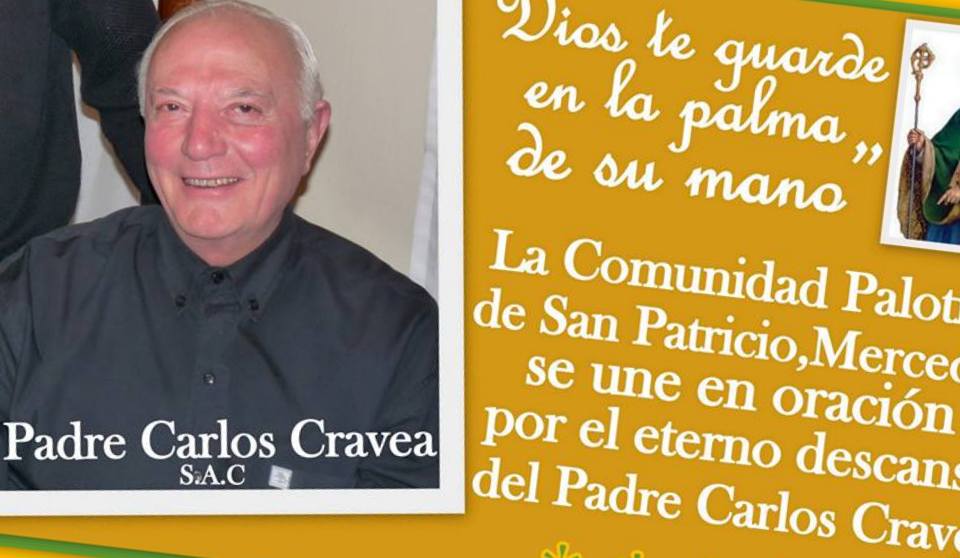
The death of Fr. Carlos Cravea SAC

Status

carlos1


Fr. Juan Sebastian Velasco, Provincial Delegate in Argentina, communicated the sad news of the death of Fr Carlos Cravea last evening. Carlos had been hospitalized in recent months with recurring thrombosis in his legs; he was diagnosed with terminal pancreatic cancer just two weeks ago.

His funeral Mass will be celebrated today in St Patrick’s Church, Belgrano, he will then be taken to Mercedes where there will be a funeral service in St Patrick‘s Church there and then buried in our plot in the municipal cemetery.

May his soul rest in everlasting joy with our Lord.

PRAYER FOR A NEW BEGINNING

Status

From pride
Deliver me O Lord
With all its attendant
Vanities

Deliver me

From perfectionism
Into Peace and
Patient living

To walk

When there is
No need to run

To stand still

When standing still
Is what You offer

To sincerely do

What is right
Regardless 

Of outside opinion


To Love

And Love well
The one with whom
I stand in the present

To bring the gift

Of Presence
To every person
Place and moment

Always remembering

That You alone are All
And hold the answer

To all our

Puzzled perplexities
Deepest searching

(Eamonn Monson sac)

THE DEATH OF FR. MICHAEL KIELY SAC

Status

Mike KielyFr. Michael Kiely died peacefully today, September 15th, at 12.55 pm in St. Vincent’s Hospital in Dublin, may his good soul rest in peace.He had been in St. Vincent’s for the past four weeks with chest problems and heart-failure, he went down over the past 4 or 5 days. He was very peaceful the final few days of his illness and was accompanied by two of his nieces and a nephew-in-law. He received a constant flow of visitors and friends over the weeks.

His remains will lie in repose in the Pallottine College in Thurles on Wednesday 16th from 5pm, with prayers and removal to the Chapel at 7.30pm. Funeral Mass will be on Thursday in the Chapel at 11.30 followed by burial in Cabra.

God bless

Derry

(Fr. Derry Murphy SAC, Provincial Rector)

Homily given by Fr. Michael Irwin SAC at Fr. Kiely’s funeral

Fr. Michael Kiely S.A.C.

We gather here this morning for the funeral Mass of Fr. Michael Kiely.  There is a sense of the surreal for me here.  The reason I say this is because just last week we were gathered here for our annual Pallottine retreat in this very College, Community and Chapel. 

Picture 009 Fr. Michael had expressed to me on a number of occasions that the best time to die would be during the annual Pallottine retreat.  He said “the lads would give me a good sending off.”  Michael was a very popular person and he was known by a very large number of very dear friends and he kept in contact with them, remarkably for a man of 84 years.  Fr. Michael was an eternal optimist, in fact the last time when he went into hospital he gave me many of his personal possessions but then he took back his driving licence and he said, “I might need that again”.  He was a very generous person and as you know money burned a hole in his pocket.

It would not be possible for me to tell you everything about Fr. Michael.  Each person here has their own story/memories of Fr. Michael.  Within this congregation there are many feelings, emotions and memories floating about today as we say good-bye to him.

Fr. Michael was from Bruff, Co Limerick and he was very proud of it.  He was born on the 2nd of April nineteen-thirty-one.  For those of us who accompanied Fr. Michael on his many visits to the Accident and Emergency departments of our hospitals we had to learn off his date of birth, when the person at the desk asked what is your date of birth: we would sing 2/4/31.

At the age of fourteen Michael came to the Pallottine College, he completed his secondary education and went on to study Philosophy and Theology in St. Patrick’s College, Thurles.  Fr. Michael was ordained to the priesthood on June 16th 1957.  In October of that year Frs. Michael, Ned O’Brien and the late Joe Harris flew from London to Nairobi, making many stops on the way. The three of them made an agreement among themselves.  They set up a rota that one of them was to stay awake at all times and that if the plane started to go down the sacrament of anointing was to be celebrated.  Fr. Michael spent nine years in Africa and he was very proud of this time in his life as a missionary.  He showed a great love for the people and a passion for the Swahili language of Tanzania.

While Fr. Michael was in Africa it is told that he was transferred to a new parish and on the first night he was badly bitten by bed bugs.  Next day, and very irate, Fr. Michael went to the neighbouring town and bought new beds for the house. He sent the bill to Bishop Winters.  We are told that the Bishop Winters, who knew Fr. Michael well, said nothing and payed the bill!

On medical advice Fr. Michael did not return to Africa.  He then continued his priestly ministry in England.  He served in many parishes in England starting with Sts. Peter and Paul, in Amwell Street, in London

Fr. Michael also spent some time in North America.  He even ended up on mission appeals in Texas.  And as it so happened the 1970 FIFA World Cup was being played in Mexico. And somehow Fr. Michael through some great friends managed to get to the World Cup. 

On his return to England Fr. Michael ministered in the following parishes, Hastings, New Barking, HalPicture 025-2stead – where he was known as “the jolly friar”, Amwell Street and also during this time he did some further pastoral studies in Heythrop College.  Fr. Michael was Provincial Delegate from 1984 to 1990. 

In October of 1995 I remember Fr. Michael coming off the ferry at Dun Laoghaire from England, in his red Ford Escort, which was packed to the roof.  This started a time in my life as a newly-ordained priest with Frs. Michael and Gerry Fleming. 

As I put pen to paper I am wondering if am I writing a eulogy or a sermon, maybe it is a bit of both.

This was the beginning of seven very happy years for me in my first years as a  priest and Fr. Michael a man of great pastoral wisdom and encouragement.  He was a “people person”, and he is famous for his card writing, the box of chocolates and occasionally flowers as well. 

In the readings of this Mass we have heard from St. Pauls’ first Letter to the Corinthians, 12:31-13:13.  In this Paul writes that there are three things that  last: faith, hope and love; and the greatest of these is love.  Fr. Michael had a great love for people and he lived it to the full. He was in no way “a gong booming or a cymbal clashing”.  In the first reading we heard from the book of Wisdom, 3:1-6.9.   The first line reads “The souls of the virtuous are in the hands of God, no torment shall ever touch them.”  Fr. Michael is now in the hands of God where there is no more sickness or pain.

During this year Fr. Michael had been in hospital six times, for an average of three to four weeks each time.  Over the last four days many people came to see Fr. Michael and spend some time with him as he was dying and to accompany us and his family.  This reminds me of the Gospel which we have just listened to from St. Like, 24: 13-16.28-35.  It is the account of the disciples on the road to Emmaus.  The disciples are heartbroken because of what has happened to Jesus.  The disciples tell their stories about Jesus just like we shared our memories of Fr. Michael in St. Vincent’s Hospital.

Picture 027Fr. Michael lived for the last three years in Pallotti House, with the student community, in Dundrum, Dublin.  He loved being around the students and he did not like the summer months when they were away.  Fr. Michael was well known for his regular shopping outings and he would always return with a treat for the community.  On the occasions when Fr. Michael joined the students for the celebration of the Eucharist he was sometimes the main celebrant and really enjoyed this.  At the communion reflection he always prayed John Henry Cardinal Newman prayer, and I feel that it is appropriate to conclude with this prayer.

“May He support us all the day long, till the shades lengthen and the evening comes, and the busy world is hushed, and the fever of life is over, and our work is done. Then in His mercy may He give us a safe lodging, and a holy rest and peace at the last.”

Fr. Michael Irwin S.A.C.

Pallottine College, Thurles 17th September 2015 

Fr. Michael Irwin sac, Vice Provincial  Director of Formation, Pallotti House, Dundrum
Fr. Michael Irwin sac, Vice Provincial Director of Formation, Pallotti House, Dundrum

PS I woke this morning about 5 a.m. and decided that I must put this homily on paper.  I cried as I put words on paper just like I cried this day last week when I celebrated the sacrament of the sick with Michael.

As I returned to my room this morning at about 8.30 a.m. to prepare for the Sunday Mass I am greeted by Michael’s opened empty room and no mention of the warm cry ‘Mike, Mike is that you?’  I celebrate the morning Mass with tears in my heart and when it came to the communion reflection I sat there with my eyes closed in silence thinking of Michael and remembering the prayer of John Henry Newman.  Some think I am praying but really I was crying for a much loved and dear friend, Fr. Michael Kiely. 

Michael Irwin SAC, 20th September 2015.

MOTHER OF DIVINE LOVE: Feastday of the Irish Province

Status

MOTHER OF DIVINE LOVE
 

A very happy feast day of Mary Mother of Divine Love to each of you. 

May our Mother lead us deeper into God’s infinite love this day.

 
It is a special day for our Province. Consecrations will be made and renewed.

Congratulations to Cyril Ingosi and Dedan Munyinyi who made Perpetual Consecration in Gallapo on September 8th.

Congratulations to Brendan McCarrick, Jaimie Twohig, Liam O’Donovan and Charles Lafferty will will make Perpetual Consecration today September 12th in Thurles.

Congratulations to Christopher Burke and Marcellus Okoth Ochola who will make First Consecration today, Christopher in Thurles and Marcellus in Ngong Road, Nairobi.

Congratulations to John Regan who will renew his Consecration today in Thurles; to Stephen Lwebuga, Norbert Mukabwa, Stephen Muli and David Kakinda who will renew their Consecration today in Nairobi.

Today we also celebrate the perseverance and fidelity of our confreres who this year celebrate significant milestones in their Consecrated Life:

Patrick Dwyer, 60 years since First Consecration;
Seamus Freeman and Philip Barry, 50 years;
Eamonn Monson, John O’Brien and Tom Daly, 40 years;
Joe McLoughlin, 30 years;
John Karanja and Eugue Kubasu, 20 years.

As we celebrate this day with gratitude let us commit ourselves with renewed fervour for the ministry the Lord is entrusting to us and to our Society.

God bless

Derry.

THE JOY OF BEING JOYFUL – Fr. Msuri Emmanuel sac

Status

  1. This is Our Life

The seed of religious and consecrated life is always germinating from the arable and nutritive divine landscape. Its beauty is never seen and vitality is never experienced without being connected into the mystery of the Trinity and the redemptive love as experienced and lived by the person. In the experience of the call and the living of the call itself, the gift of consecrated life is surfacing to nourish and share the joy of being graced by participating in the salvific mission of our heavenly Father and that of the church.

As consecrated life takes the image of Christ in the calling, in its formation and in mission; in it is a personal decision to walk the talk by leaving everything and fundamentally making one’s life ready to faithfully live the big Yes, the yes that says ‘here I am.’ Thus Lumen Gentium reminds us of the Yes of our baptism which is completed and perfected when we consecrate ourselves wholly to God in the totality of love.   

The Christological and Pneumatological nature of the consecrated life invites the participant not only to follow and live Christ radically but also to open oneself to the workings of the power and the gifts of the Holy Spirit. The imitation and the special gaze on Christ’s face are to illumine our deepest selves so that we may joyfully radiate the presence of Christ to all and at all times. Our partnership of life of our very selves, with the gifts of the Spirit are for constantly being renewed and energized to live to the demands of our call and the mission ahead of us, as Vita Consecrata says, there is ‘going up the mountain and coming down the mountain.’

The joy of accepting the invitation of Christ has to be the joy that accompanies us in living our call and mission. When the year of consecrated life was announced, the message that is accompanying us to ponder and reflect is the reality of this joy. In whatever moment and situation, Pope Francis is inviting us to rediscover the deepest root of our calling in joy. Our lives individually and communally, in mission and apostolate are to continually radiate the presence of joy, to the extent that where there is a consecrated person, there is joy.   

  1. It is in Us……Joy

Consecrated life is never a life of emptiness and in emptiness. As it has its foundation, its mission and gracious return in faithfulness and joy; in it are the consecrated men and women who heed to its demand and its call. There are different calls into it as important as the other, and this year, joy is our necessity and in deed our greatest demand. It is never a small matter because it holds certain other things that open up further understanding of our relationships and mission.

Since time in memorial joy has been fundamental to the existence of humanity and to its well being. It is a word and an experience that has been accompanying men and women of this world. When denied, life and its dimensions are denied. Life is turned upside down and becomes gloomy, dull, miserable, dysfunctional and dreary, depressing … etc. When freely lived and shared, joy brings delight, humor, content, friendship, love …etc.

The anthropological experience of man in his state of being and nothingness reveals his different capacities, both positive and negative. Not only can he transcend the state of life’s limits, he can also vision ways of living a better life. He operates in this through hope which is in him making the spirit of yearning and eagerness important factors. As joy could be minimized to the periphery of one’s life, it is the yearning for goodness within the capacity of our being that can once again revive and centralize joy in our lives. The tension between consistency and inconsistency in maintaining the state of goodness in joyful endeavor may be corrected and balanced by continually reviving our yearning, our goodness and understanding our limits for better complementarity. It is our faithfulness, our consciousness, it is our state of being in choosing what build our anthropological relationships than what leads to its collapse.

When saint Augustine says ‘my soul shall not rest until it rests in God,’ it reminds us of this spiritual and anthropological yearning which transcends us to the divine presence. We have been created for a great and valuable life. Hence when we open ourselves to the divine and higher values, we are exposing ourselves to that contact with our Creator who is the first source of our joy. We rise beyond human capacities and limits because we are no longer the ones but “the spirit comes to our aid” to help seek what is deep and fundamental to our spiritual corporality.

When we sing ‘give me joy in my heart keep me praising…’ we seek divine intervention and presence, we seek the perfection of what is ordinary for the greater well-being of the body and soul in union with God. Jesus speaking to his disciples before his departure in the gospel of John, insisted on joy being perfected, being fulfilled in them. As it is never fulfilled when it is too human, the invitation is to ground that joy in the continual loving relationship with God. At this point, this is how it opens itself; joy is love, joy is relationship and joy is connected to other dimensions of our call and life as Christ’s true followers. That is why in Paul joy is part of the fruits of the spirit (Galatians 5).

What is our call in this divine-man relationship? A life of deep and persistent joy elevated to the divine presence indicates that we live the life of the Spirit and have immersed ourselves in the Divine presence. In it and in the consecration of our life, we continue having a shining star, to guide and motivate, to instill in us a persistent walk of great moments of rejoicing. We become the manifestation of true liberation in spirit and a sign of gratitude to our different situations and circumstances in maturity, in true nature and true interaction. Our joyous present moments in spirit are not isolated from our future dream of encounter. Thus joy is eschatological when is enriched and graced with our hopes. It points to the future, the destiny of our faith and our commitment to its values. Its sacredness is in its goodness, its transforming power. Its sacred inspiration is its constant call to embrace the source of all joy, God himself.

  1. Experiences of Joy

Joy is a human experience with its own signs, symbols, gestures and moments in human terminologies. As is our reality of our everydayness, joy helps to us learn, remember and adapt. Joy makes us who we are, what we do, why and how we do it and to whom. Joy has its own intensity, force, power and strength when experienced and lived. And we have to agree that to rejoice, to be joyful is a decision, a choice. Look at St. Paul in 1 Cor 6:4-10 when he says “…we are treated…as punished and yet not killed, as sorrowful yet always rejoicing…” Job also in 19:25-26 sounds the same.

In the midst of troubles, problems, difficulties, mysteries, paradoxes, sickness, brokenness, fragility …what is my reason of acceptance and of rejoicing. What is the reason of the sick men and women who are in constant pain and tribulations (like Paul) but are never silent of their hopes and their joy? How many times have we seen our sick brothers and sisters portraying a stronger inner energy and a greater sense of acceptance compared with those who are strong and healthy?

What was the source of joy of the first missionaries, the joy of those who go to open new missions, the joy of those who take risky and challenging apostolate? How about the joy of consecrated men and women whose thoughts and energies are directed to places where things have not been easy, places where everyone else pulled out, but are determined to stay put and share their love and joy? How about those who from the first day of their consecration and apostolate placement have seen life in its periphery and is their joy to be where they are mostly needed?

As consecrated men and women, our choices on the state of our life and our being are crucial to the foundation and development of the person. If we responded to our divinely inspirational call of ‘rejoice, rejoice, and again I say rejoice…’ we would be walking on a greener path of the presence of life, joy and love. Not only would we encounter the shining light but we would radiate that presence. We would echo back the great sound of personal victory which speaks to our hearts and spirits invoking strength and determination no matter what. We are brought to that relationship with divine gifts, grace and strength. All these are to aid our human nature to discover true value in rejoicing.

A consecrated man and woman never define himself or herself without his or her fellow kaka (brother) and dada (sister). This is what defines us as people with communitarian character. We not onlyt live and stay together, but we journey, share and experience the dynamics of our life and apostolate together. It is pity for a newly consecrated kaka and dada to begin his/her responsibility in a non-joyous community or where personalities are never in communitarian spirit. The begging question is: have we prepared him/her for such a situation? Are we confident of his/her tools of interaction in that reality? Do we have to think twice before such a decision?

In all that we do and think as consecrated men and women how are we perceiving and expressing the sense of community life? As this is a place of ‘together we journey, together we rejoice,’ its fundamental details need to be revived and its spirit needs to be rekindled. It was never wrong in the African systems of thoughts and life when it was said ‘I am, therefore we are.’ And it is never wrong in our consecrated life to continue saying the same, and even more so in the words ‘I rejoice and therefore we rejoice’ and vice versa. Thus in this year of consecrated life, let it be the year that I question my role in building up a community. Lets question our status of communitarian character. Let’s question our fraternity, our love, our forgiveness, our support for each other to heal ourselves and heal our communities.

We need to carry in community living four things: love, forgiveness, joy and hope. Do they substitute each other? Is one better than the other? Our deepest ambition should be to bring them together in the bigger basket of consecrated life. It is this ambition and desire in us that will set a purposive direction; bringing to light what is valuable for each one of us. A life of self-giving love is what we are reminded about, a life of generosity, of service and of practicality as we commit to each other in following Christ, as I borrow these words of Saint John Paul II in Vita Consecrata. As consecrated persons in our communitarian life we are invited to love and care with the heart of Christ. It is the invitation to amend and heal with the compassion of Jesus, to welcome and to give hope. We are to joyfully celebrate our communion and companionship in the light of divine presence. 

If communities of consecrated life are to embrace our Lord and the gracious presence of our heavenly mother Mary, will never be lacking love and joy. Our communities of consecrated life will never be a place of inner and silent death. We will never suffocate each other, exclude each other, eliminate each other, suppress each other or speaking evil to each other. As we embraced Jesus with the ‘Yes’ of consecrated life, we will embrace each other mercifully, lovingly and joyfully.  

Let’s Question Ourselves Joyfully:

  1. Am I finding meaning in my consecrated life in the presence of God?
  2. As consecrated person, where am I searching for my joy? Is that a real joy in the consecrated life?
  3. In my involvement as an entrepreneur of joy in its divine and bigger picture, is my personal goal contributing to that of the other?
  4. Am I widening the circle of information on the beauty and goodness of joy, communicating it, coordinating it?
  5. Do we still have hopes and joy to continue working despite the challenges, resistances, failures …etc.?

Consecrated life is a precious and beautiful life in itself. It is a gift, a special divine gift. Our commitment to it is in loving our God and the mystery of our salvation in the life of the Trinity. In moments of Eucharistic celebrations, prayers of the church, meditations, our spiritual renewals in recollections and retreats, personal and community prayers, we are brought close to God and to each other. In them, together as consecrated persons, we walk on the road leading to joyful sanctification.  Constantly we are to ponder God’s ways and God’s word to understand the dimensions of His great love for us, and vision our joyful response. The fragrance of our consecrated life is to perfume the individual person first, then spreads and perfumes my kaka and my dada and brings us closer to the source of its joy and its beauty which is God. In the beauty of its fragrance, together we rejoice and are glad.

“The joyful heart sees and reads the world with a sense of freedom and graciousness.”

John O’Donohue

A Peace And A Beauty Overcame Me: Vocation Story by Charles Lafferty sac

Status

            When I’m asked to say a little about who I am, I normally answer around the area of identity – I recall a few Charles Lafferty sacdifferent articles that have had this theme – and so as I set out to write my vocation story, this again popped into my mind – as if this was my hobby horse. I would normally use Matt 16: 15 (where Jesus asks his disciples who they say that he is) to identify with my vocation story – I normally did this as if Jesus was then asking me who I am; but I recently was reading and praying with Tobit and came across this piece: I will now declare the whole truth to you and will conceal nothing from you (Tobit 12: 11). The setting for this is that the Archangel Raphael is about to disclose his identity to Tobias, who he has travelled with when trying to get a cure for his father’s blindness. The disclosure of God in our lives can mean a lot for the journey that we have travelled and it is only through reflecting upon my journey that I can see God truly working with and through me.

            I’ve never written the following, but I have spoken about it to a few different groups: when I was growing up, it was quite hard for me to know who I was. At first I was known as Mr Lafferty’s son – my dad was a primary school teacher at the school I went to and, mercifully enough, I was never in his class!! But that didn’t stop other teachers, parents and strangers from pointing out ‘are you Mr Lafferty’s sons?’ Of course this was probably an easy way out because I am a twin as well – so if it wasn’t ‘Mr Lafferty’s son’ it was ‘you’re one of the twins.’ This continued for quite a while – I have fond memories of growing up and yes, Harry (my twin) and I did play a few tricks with friends and family. Until we were 15 or 16, Harry and I always had to wear different coloured shirts to avoid too much confusion. The fond memories included growing up in quite a faithful tradition and environment – I remember one of my granny’s taking each of her grandchildren aside and praying with them and to encourage each of us to consider our vocation. I probably got on better with my other granny as she always had a biscuit tin for each of her grandchildren!!

            As I grew up though, I wanted to experience life and I went off to Queen’s University, Belfast where I studied Chemical Engineering for four years. My practice of faith during these years would not have been the same when I was in the family environment of Derry. This continued for a few years after, even when I had returned home, until I was kindly asked and invited to read one weekend at Sunday Mass in our parish. This invitation came from my mother and as many Irish people can testify to, it’s very hard to say ‘no’ to mammy!! This loudes-basilica1breading at Mass then became a monthly event, before coming a weekly event and then the next thing I know I am actually helping organise the Liturgy of the Word for parish. During this time, as well, I was invited by my parish priest to go on pilgrimage with the diocese to Lourdes. I remember politely declining, thinking that I was doing my piece for the parish. One day as I was entering the house, my dad answered the phone and I just remember hearing him say ‘Of course Fr Neil, Charles is looking forward to going to Lourdes.’ The terror that struck me as I went on the bus to the airport was on a new level compared to before – public speaking was fine, but making a public witness to my faith in this way was not something I thought I would be good with. The journey to Lourdes didn’t help either: we lifted off from Belfast at around 8am and with two pit stops in Dublin, we finally arrived in Lourdes at around 8pm local time. I remember seeing the candle light procession from on top of the main basilica and there was just a peace and a beauty that overcame me. I was standing with some friends (two guys and three girls) and there was some amount of tears being spilled – in gratitude for being there after the journey, for being there with each other and I think for being in the presence of God.

            Needless to say, I had a complete ball, made so many new friends and wanted this to continue that I immediately signed up for going to a summer youth festival. This inspired me to get more active within my parish and in Derry and all of this helped me grow in a personal relationship with Jesus. There was so much fun, joy and excitement in this circle of friends and that as I continued to grow in service for the parish and in Youth 2000, I realised that I was enjoying this way of living – working and living for God. Previous to this I was a bit nomadic – travelling up and down to Belfast for a management course, then to Magherafelt for a job in a bakery as a quality assurance officer and then getting a job in Derry in computers. With Tobias, he was handling a fish as a cure for his father’s blindness – if anyone knows me, then they know that I do not like fish. As I was doing more and more with my faith life (how I like to imagine the fish), growing in that personal relationship, it was as if my own blindness had been lifted. I realised that perhaps God was calling me to be a priest. It took me over a year to discern what sort of priest – not being fully accepted by the diocese hurt quite a bit and through a meeting with Fr Emmet in Knock, I came in touch with the Pallottines. I had met a few Pallottine priests through Youth 2000 and their personal touch and witness inspired me to look deeper with the Pallottine family. I went to a few different retreats and in September 2010 I started life with in Dundrum with them.

           St Vincent Pallotti by Fr Witold Urbanowicz, SAC I heard in my first Pallottine community retreat of how St Vincent Pallotti would come in front of the Blessed Sacrament and ask two questions: ‘who are you God?’ and ‘Who am I in front of you?’ I truly believe that as I have travelled on my journey of faith, it has been easier for me to see who I am – not just Mr Lafferty’s son or one of the twins; but that I am a child of God. This period with the Pallottines has been an unbelievable and grace-filled time for me (with a few bumps along the way) but I know that God has a path for me with the Pallottines. In this, the Year of Consecrated Life, I look forward with joy to making my Final Consecration of Pallottine promises in September, along with three of my fellow brothers. Please pray for all of us as God continues to declare the whole truth to each of us in his special and loving way. I also wish to give thanks to all of my family, but especially to my mum and dad; and to my two grannies who continue to send their blessings from their eternal reward.

St Vincent Pallotti, pray for us.

Our Lady of Lourdes, pray for us.

Most Sacred Heart of Jesus, have mercy on us.