
[dt_divider style=”narrow”/]

WELCOME TO PALLOTTINES IRELAND
Pallottine Fathers and Brothers
[dt_divider style=”narrow”/]
We had a Union of Catholic Apostolate day of recollection in Dublin at the beginning of December, our theme was ‘Living the spirit of Advent 2017’, and I have continued to reflect on this topic for the past few weeks, conscious now that it is turning in to ‘Living the spirit of Christmas 2017’. A few very simple things strike a chord with me.
On Saturday 16 December Archbishop Diarmuid Martin, Archbishop of Dublin, ordained to the diaconate our student John Regan and a Spiritan from Hong Kong, Samson Mann; his homily was a strong one focusing on the origin of the ministry in the life of the Church and the challenges facing the Church today in living the Gospel. The Church must, like our Lord Jesus, take flesh in every age and in every culture and circumstance, and that is both exhilarating and challenging. Nothing short of a total commitment is the message. One image stood out for me in the homily, and I will quote the passage: “John and Samson: as you present yourselves here before the Church this morning in answer to God’s call, remember that ministry and witness are not external actions. Ministry is not like any job that can be done at various junctures and then left aside. Ministry has no dimmer switch that I can tone down or turn up with greater intensity just as I wish. Witness to Jesus Christ means total identification with Jesus.” Ministry has no dimmer switch that I can tone down or turn up with greater intensity just as I wish. And of course I had a mental image of myself fiddling with the dimmer switch. Archbishop Martin is correct, it is a matter of total identification with Jesus, just as Jesus totally identified with us, with our world, with all of humanity, when he took flesh and became for all times Emmanuel, God-with-us.
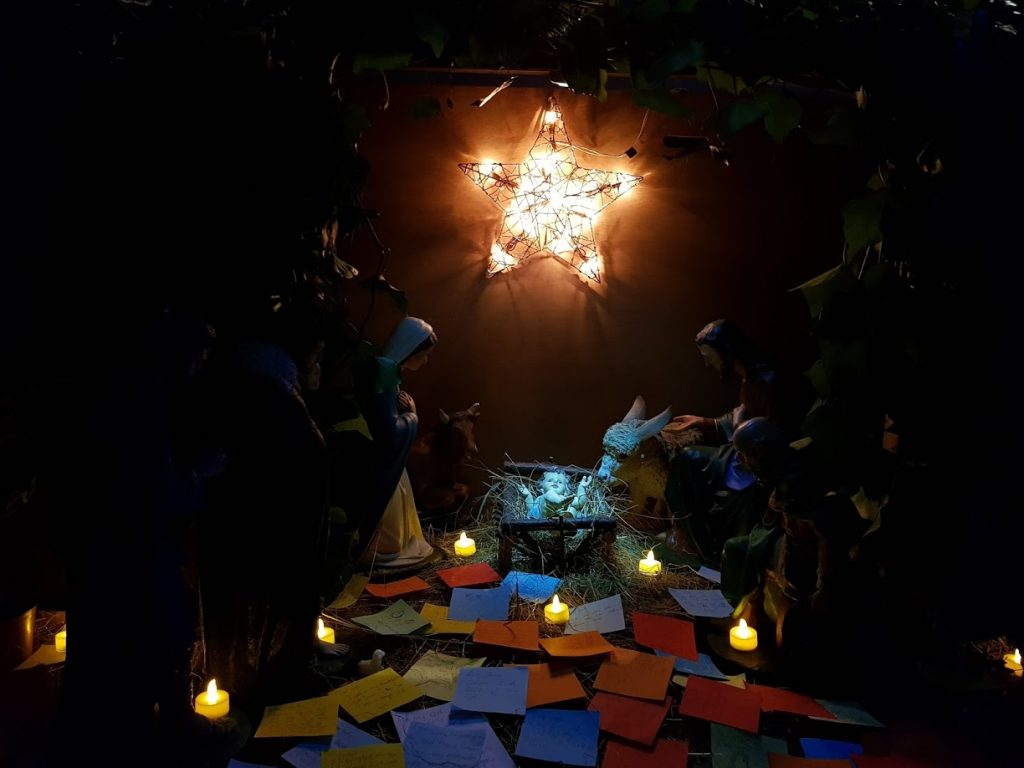
While visiting England I spent a weekend in Hastings with Fr Eamonn Monson, the crib had been put in place before the altar, but it was bare, empty, Eamonn had his reasons for leaving it bare, he explained that the shepherds did not arrive 3 weeks before the birth, they were in the fields doing their job, but the stable was there, the manger was there. So in the crib in Hastings there was a crib, with no adornments, and an empty manger, and thus it was to stay, until the birth of Jesus. Waiting.
I went to a funeral Mass in Sandyford on Tuesday of this past week, and the crib there was ready, all the figures in place, and lo and behold, in the manger there was a large open Bible, open at chapter 1 of St John’s Gospel where we read “In the beginning was the Word and the Word was with God and the Word was God.”
The mangers in Hastings and in Sandyford are both powerful statements of aspects of the one and the same mystery, Emmanuel.
A cousin wrote and she mentioned her Christmas preparations, in her home the three Wise Men begin their journey at the start of Advent upstairs in the house; each day of Advent they advance a little, and then start to descend the stairs, one stair, one day, at a time, until they arrive to present their gifts and adore. A mirror of our Advent journey.
Our Holy Father Pope Francis is a constant source of hope for me. Last Sunday he was 81 years of age, and he celebrated with a 4 metre, or 13 foot, long pizza, which he shared with the children of the Vatican Paediatric Clinic in the Paul VI hall, and the newspaper headline reads “Pope Francis encouraged the children to dig in, telling them that they should: ‘Eat all four metres’ as it would make them grow”, and it was accompanied by a photo of Pope Francis surrounded by children in front of the epic pizza and blowing out a single birthday candle. Pope Francis can teach, preach, write homilies and discourses, encyclicals and exhortations which illumine the Church, but it is also in simple gestures such as this birthday celebration that he communicates the joy of living the Gospel of Jesus in the flesh.
May our Christmas be a celebration of our God, who is simply present. And I conclude with a prayer sent to me as a Christmas greeting by our confrere Fr Wolfgang Weiss “God is present here for us. And what does this presence of God in the Child of Bethlehem say to us? It says to me, it says to you, and says to every person, it is good that you also are present.”
Derry Murphy, SAC.
Provincial

Mary, you stand at the crossroads
Of time and eternity
Intersection of all creation
A desire as old as Eden
Burning in your soul
The yearning of every child
Who has graced the earth
Embodiment of humanity’s Hope
Of Redemption, Restoration
You have held in your heart
The wandering aridity
Of the desert and there
God comes to find you
Lifting you up and keeping
You the apple of His eye
Humanity has found
A response to God in you
From you is deliverance
Brought forth in Christ
In whom we are born and breathe
Our perfect peaceful consummation
Healing for our scars
Amen
 The oil in the lamps of the bridesmaids (Matthew 25:1-13) represents the grace that God has given us to help us encounter Christ in our life experience. It is the grace to wait in the time of waiting and it is the grace to go out and meet Him when the time for going out has arrived. It is the grace of alertness, the grace of vision and the grace of action.
The life of grace is not so much a state of ethereal tranquility but more a powerful impulse that sends us crossing vibrant, stormy seas; a climbing of steep ascents that leaves us gasping breathless. Grace is an adventure into the mystery of God, an adventure in which we stumble and fall; it is a bruising and a breaking. It is rest after struggle and healing after hurt, a healing that is greater than the hurt, a grace that we would never know without the hurt. There is always hope in brokenness. In God nothing and no one is damaged beyond repair.
The thing about this grace is that it is personal, given uniquely and differently to each one of us. It fits the person that we are, is designed specifically for each one. So, it cannot be passed on to another or shared even if we would like to. That’s not to say that we can’t help another to experience their particular grace but we can’t give it to them. It is not ours to give. It is God’s!
The story of the bridesmaids is a sober reminder to us to treasure grace, to use it or lose it. At least that we try to use it, strive to search for Christ every day of our lives. Strive! This is a word used by Jesus and it’s a word that offers us hope. We don’t have to get it perfectly right. We just have to try!
When I was a small boy I had and beautiful red car, a toy that I loved and played with constantly, revved it up so much that it broke down and wouldn’t work any more. I was very desolate so my mother said I should leave it on the window sill in my room and maybe Santa would take it away and fix it. That night I did what I was told and next morning the car was gone.
I didn’t really expect anything to happen but, when Christmas came, there in the midst of my presents was my lovely shiny red car in perfect working order. As good as new!
In later years when I was going through a very difficult period in my life and not coping very well, one Christmas my mother handed me a gift and to my delight, what was it but a red car similar to the one of my childhood. She said nothing but I knew that she was telling me that, as the broken car of my childhood got fixed, so would I too get somehow fixed beyond my brokenness. And so the red car became for me a symbol of hope, the hope of being restored, repaired when I was damaged and broken.
This is central to the grace that God gives us – that we have hope when things are hopeless; that we watch out for signs and symbols of hope. In the battlefields of Europe during World War I the red poppy became such a symbol of hope. There in a land that was torn apart and scarred by the savagery of war; there in the midst of such destruction and death, the impossible happened when the fields blossomed with beautiful red delicate poppies.
There is significance in the delicate nature of the poppy. In it God is telling us about the power and resilience of what is frail, what is delicate and refined. It is a symbol of the grace that is given to us, that we so often reject because it is frail. But as we are reminded in the Bible – the weakness of God is stronger than man’s strength, the frailty of God is far more enduring than any human power.
All of this is embodied in the reality of Jesus whose life on earth began in the frailty of a baby and ended in the frailty of the condemned on the blood red cross, the silent sleeping of a body in the hopeless tomb. And out of that hopelessness He emerged into new life so that we might emerge from our brokenness into lives that are truly transformed and, even though we bear the scars of our wounds, they are themselves the scars of transformation.
Red, the colour of hope – red cars, red poppies and the red blood of Christ by which we are redeemed. Just as in the mystery of Christian life we wouldn’t know the wonder of mercy if we hadn’t sinned, so we wouldn’t know the sheer pleasure and wonder of being healed if we had not been wounded in the first place. Grace abounds all the more!
+++
 Postscript: I spoke about this today in my homily and after the 11.30 Mass a four year old girl came and handed me this little red car which she found in the church and thought I should have it because of what she had heard me say. The Lord speaking to me again in the unexpected gift of a red car at the hands of a child. If anyone knows who this car belongs to I’ll keep it safe till next week.
Eamonn Monson sac, Hastings
(Click on the image below to see more photos)
Fr. Joseph Campion, SAC, (1937-2017).
Dear Bishop Seamus Freeman, Monsignor Michael Ryan, my dear brothers and sisters (or, as Fr Joe would say, my dear sisters and brothers). We are gathered here today to say ‘slán go fóill’ or ‘adios’ to Fr Joe, or Fr Jose, as he was known to many. We bid him farewell in the sure and certain hope engendered in the First Reading from the prophet Isaiah (Is 25, 6-9) at this requiem Mass, the sure hope that Fr Joe is at the heavenly banquet with God, the Father, the Son and the Holy Spirit, and that what is promised here in Isaiah, ‘a banquet of rich food, the removal of mourning, that the Lord will wipe away tears from every cheek, will take away his people’s shame, and will destroy death forever,’ is Joe’s experience, his reality, now. We are blessed that we can turn to Sacred Scripture for consolation, peace, encouragement and even correction at times, and Joe’s niece Caitriona and her cousins knew that they would find in the Bible the readings that would speak to them in their sadness at Joe’s death when they were planning this Mass.
Both the first and second readings today are sources of strong hope; Isaiah was writing seven hundred years before the coming of our Lord Jesus Christ and in this reading we have one of the first references to eternal life in the Bible and what it might be like, it is presented as a lavish banquet, a special heavenly banquet where tears are wiped away, where shame is removed, mourning is ended, and most importantly of all, where God will destroy death forever, he will destroy the power of death to engender fear and to take heart from us as we live.
Our vision is sharpened with the second reading from the First Letter of St John (1 Jn 3, 1-2), written nearly eight hundred years after the Isaiah reading; John, the apostle and evangelist, shares the conviction of his old-age regarding the after-life, both the element which is unknown, and cannot be known, and also the spiritual certainty which is the fruit of years of reflection and prayer; it can be summed up as: (1) we are God’s children; (2) God lavishes his love on us; (3) our future is to be like him; (4) because, we shall see him as he really is. This is the hope, and the vision, which shaped Fr Joe’s life; from a very early age he sought God, he sought intimacy with him and after some initial years of searching which brought him to the Pallottines, to a short time with the Divine Word Missionaries, and some months in the Cistercian Abbey in Roscrea, he settled on the Pallottines and what was to be his spiritual home for the remaining 59 years of his life. You his family, his parish community, and we his Pallottine community, knew Fr Joe as a man of prayer, but there was nothing flamboyant about his life of prayer, he was not a man to engage in the various prayer movements which sprung up in the Church, he was a steady man of prayer, committed to community prayer, the Divine Office, Mass, the Rosary and his annual spiritual retreat. Fr Joe sought God and he is now with the God he sought throughout his life.
Fr Joe was a man who had very strong convictions which were based on the Gospel of Jesus Christ, and no doubt his convictions were also shaped by his experience. We are known as ‘the Pallottines’ but our proper or official title is ‘the Society of the Catholic Apostolate’; we are an apostolic community, centered on the apostolate, and that certainly was Joe’s life commitment, to the apostolate, to whatever work as a priest was put to him in his 52 years as a priest, and he was faithful up to the very end. As you know Joe had some health issues from May onwards and he was out of the parish for quite a while, but he was very, very happy to be back in the parish for the past month and to have been able to return to ministry in Castlecomer. As a Pallottine Joe ministered in Argentina from January 1966 up to 2003; he started off in the church and school of San Patricio in Mercedes; from there he went in 1975 to the parish of the Immaculate Conception in Rawson, which is a very rural parish but which covers a vast area; in 1979 he was appointed to the parish of Our Lady of the Rosary in Suipacha and while there he was also Director of the Secondary School of St Luis Gonzaga; in 1991 he was appointed to the Instituto Fahy, a boarding and day school in Moreno and when his time there ended he was appointed parish priest of the parish of San Patricio in San Antonio de Areco; he returned to Ireland in 2003 and was appointed to the parish in Freshford by Bishop Laurence Forristal and finally he came to Castlecomer. Fr Jose made a lasting impression wherever he worked and he also made life-long friends in each appointment.
Events in the Argentine in July 1976 marked Jose; five Pallottines, three priests and two students, were murdered in the parish of San Patricio, Belgrano in Buenos Aires on July 4th, and from then onwards Jose had an abhorrence of violence in all its forms and expressions. He was profoundly saddened by those events and found it very hard to understand such cruelty to fellow human beings and the ability of the perpetrators to return to ‘ordinary life’ after such acts. His abhorrence of violence extended to denouncing it, to avoiding conflict and arguments in the community and all visual expressions of anger and violence. On a lighter note I will share two examples of this with you; Joe’s niece Caitriona remarked that he could not even bear to watch a rugby match; many years ago Joe and I went to the cinema in Pinamar when we were on holidays together, the lights dimmed, the film started and Joe began to show signs of discomfort which quickly became audible, the ‘oohs’ and ‘aahs’ became louder and louder as did his questions and comments regarding the protagonists, this all resulted in others urging him to ‘shsssh’, it was an uncomfortable evening, and it was not a violent film! Fr Jose was a man of peace!
I have left the reflection on the Gospel reading until now, the passage was specially chosen by Msgr Ryan and it is so apt for Joe’s funeral Mass. In this reading from the Gospel of St Mark (Mk. 10, 13-16) we hear the teaching of Jesus Christ on the Kingdom of God and on children. Fr Joe insisted that children be active and protagonists in Mass, this came from his understanding of today’s Gospel reading with Jesus’s attitude towards the ‘little children’ and he was convinced that children are the future of the Church, if there are no children involved in the Church and its liturgy, there will not be a Church of the future. Many people have spoken of this aspect of Fr Joe’s ministry since his death, some referred to it fondly, others with some exasperation, his insistence on the protagonism given to children produced mixed reactions, but Joe was adamant that it was his way.
Many tributes have been paid to Fr Jose since he died last Saturday, tributes from Freshford and Castlecomer and in particular from the Pallottine communities in Argentina; the school secretary in Suipacha recalled how as a young girl Fr Jose had them put together home-made rosary beads and take them to the railway station in the evenings before Christmas and distribute them to the passengers on the evening train while it was stationary and all the while they sang Christmas carols. And that is just one example of tributes and memories shared in recent days. Fr Joe has left a lasting legacy, he was a man of prayer, a man of peace, a priest committed to the apostolate, a man who gave public witness to his faith; and how necessary this is today. Yesterday I was in transit at Frankfurt airport on my way back from visitation in Argentina, I had a five hour stop-over, I saw signs for ‘prayer rooms’ and followed them, the three ‘rooms’ were in the same area, I entered the one marked ‘chapel’ it was a Christian ecumenical space with opaque glass walls, I prayed there for an hour or so, and could hear the door of another room open and shut frequently, I was distracted and looked and saw that it was the door to the Muslim room, I would estimate that at least 30 to 40 persons went in to it in the hour I was there, but I was the only person who entered the Christian chapel in that hour. It gave me pause for thought and I wondered about our Christian faith and the decline in public expressions of it in a place like an airport. Fr Joe lived his faith publicly and in the apostolate, we have received a legacy from him, perhaps a way to honour his memory would be our commitment to do likewise in our lives.
On behalf of our Pallottine community I offer my sympathy to Fr Joe’s sister Frances, his sisters-in-law Statia and Tess and his many nieces, nephews and extended family. A very sincere word of thanks to Msgr Michael Ryan parish priest and Diocesan Administrator, Fr Joe was very happy and fulfilled here in Castlecomer and happy to be working with you over these years, I know that he felt supported by you and that you made a good team. Thanks to the parish community of Castlecomer for all you have shown Fr Joe during his time here. Thanks to his family, and in particular to his nieces who were so good to Joe in recent months when he was not well. Thank you to Bishop Forristal who welcomed Fr Joe into the Diocese of Ossory and appointed him to Freshford, to Bishop Seamus Freeman, our Pallottine bishop, who appointed Fr Joe here, and thanks to you all for your presence here today.
This Requiem Mass is being live streamed and I know that Jose’s friends in Argentina are participating via streaming. I would like to read a message to Fr Joe from EL ARCA Movement in Moreno, a charity dedicated to poor children which Fr Jose supported, the message is directed to Jose: “Dear friend, we wanted to be present at this farewell. You were very important for everyone involved with EL ARCA through the years and working so that this world be a little better. From the day we met, your smile and your unconditional love always accompanied us. You were a great man, one of those who illuminate, who generate good things and who make better the places where they go. All the boys and girls who went through EL ARCA always remember and remind us of your greeting “Hello” and also your well-use phrase “Continue to be happy.” Dear friend, thank you for everything you did for us. Your sensitive soul and spirit will spread among all those who had the good fortune to meet you. You will always be an example for us and you will remain in our memory. We carry you in in our souls.” Betina Perona and all at EL ARCA.
Regina and friends of Fr Jose from Suipacha recorded some hymns for this Mass and sent them via link, we will now listen to one of them, and its title is “How lovely it is to see walking down from the mountains the feet of the messenger of peace.”
Fr Derry Murphy, SAC.
Provincial Rector.
|
|
Fr. Joe (José) Campion, SAC C.C. Castlecomer, Co. Kilkenny and formerly of Lisduff, Errill, Co. Laois. Fr. Joe died on Saturday 21st October peacefully in Saint Luke’s Hospital, Kilkenny after a short illness.
Deeply regretted by his fellow Priests and Brothers of the Pallottine Society, his sister Frances Conroy (Portlaoise), sisters-in-law Statia (Lisduff) and Tess (Levalley), nieces, nephews, grand-nieces and nephews, great grand-nieces and nephews, cousins, relatives, retired Bishops and Priests of the Diocese of Ossory & also a wide circle of friends both in Ireland and Argentina and especially in the parishes of Castlecomer and Freshford.
He is pre-deceased by his parents Edward and Margaret Campion (Lisduff), sisters Joan Fitzpatrick (St. Theresa’s Nursing Home, Thurles), Mary Raphael (died in childhood) brothers, Miko (Cork), Charlie (Lisduff), Eddie (Walkinstown and Donaghmore), Peter (Drimnagh), Paddy (Levalley), Noel (Clontarf).
Reposing at Coady’s Funeral Home, Castlecomer on Wednesday 25th October from 6pm with Vigil Prayers and Rosary at 8pm. Reposing at the Church of the Immaculate Conception, Castlecomer on Thursday 26th October from 4pm. Reception Prayers and Rosary at 7pm. Requiem Mass on Friday at 12 noon followed by burial in the Old Cemetery in Rathdowney, County Laois.
No flowers please, donations if desired to the Pallottine Fathers for the continuation of Fr. Joe’s Missionary Work of 40 years in Argentina.
Reception Prayers & Requiem Mass can be viewed on www.castlecomerparish.ie. “Ar dheis Dé go raibh a anam dilis” |
Fr Philip McNamara, SAC, (1931-2017).
Readings Requiem Mass: Ecclesiastes 3:1-11; 1 John 3:1-2 and John 12:23-26
 In our Pallottine Community Prayer Book every evening there are three questions/reflections with the word ‘pause’ printed for thought or consideration. On Tuesday evenings we read ‘Let us consider that one day we must die. Let us pray for faithfulness and a happy death.’ There then arguably follows the shortest pause of the entire week.
There was something strange about celebrating Mission Sunday in the weekend just gone. Phil Mc Namara was, is and will be one of our Province’s great missionaries. He had and retained a huge capacity for work wherever he was appointed. Whilst stories and memories have emerged from Argentina over the weekend I think it is fair to say that it is in the United States that most of the stories and memories are based. There’s a verse in the Old Testament reading that bears particular attention today: ‘a time to plant, and a time to pluck up what has been planted’ or as John O’Donohue might say ‘Bloom where you are planted’ whether it was here in Killoscully, in Argentina or in his beloved Stephenville, Texas. Phil not only blossomed but helped innumerable others to bloom and that is an outstanding quality in him and a feature of his life. It was never about himself.
Fr Phil was ordained on June 12 1958 and was first appointed to Argentina: Mercedes and Suipacha were his places and then in 1972 he was appointed to Lubbock in Texas. Seminole, Stephenville, Granbury and Weatherford were other placements and then in 1998 he returned again to Stephenville. Between August 1978 and February 2015 Phil was appointed there three times.
Stephenville is a vast territorial parish of 4,800 square kilometres! or 1,823 square miles! That’s a large area to cover, there are four worship sites as the Americans call them or four Churches – in Stephenville, Dublin, De Leon and Comanche, plus he cared for Catholic students at Tarleton University in Stephenville. Our Pallottine history books tell us that it is 36 miles or 58 kilometres from Stephenville to Comanche. Killoscully to Shannon is closer – so is Killoscully to Thurles. From here to Urlingford is less than two miles further; or to Ennis is maybe five miles more. This was the territory in which Fr Phil bloomed. Indeed the family tell me that on a Facebook page set up since Phil died there are almost one thousand messages in Spanish and English remembering him fondly.
We Pallottines are the Society of the Catholic Apostolate. The word Apostolate implies work! Fr Phil Mc Namara could never be accused of shirking the apostolate or his pastoral care of the people. He preceded the often quoted statement of Pope Francis to the ordained: ‘Preach: and if necessary use words.’
We Irish can be accused of being obsessed with the weather and it forms a good part of many daily conversations. Last week we experienced Hurricane Ophelia and some people unfortunately died directly as a consequence of this hurricane hitting Ireland- the worst in fifty years. There could be another hurricane long after some of us are gone but I doubt if any of us will ever encounter such a human force as Fr Phil again in this lifetime.
One of a kind; – kind and generous, loyal, determined and maybe even at times head-strong. If he thought you were right he backed you publically and it didn’t matter who was on the other side. If he thought you were wrong (or in his mind if he knew you were wrong) you knew. There was no ambiguity in Phil. If you didn’t know what Phil Mac was saying you were not listening – so he would tell you again, making sure you were paying attention on this occasion.
Next May we Pallottines will mark 200 years since the Ordination of our Founder St Vincent Pallotti. There will be articles, publications and talks on the theme. In our Vigil for Phil we prayed: ‘Confident that God always remembers the good we have done and forgives our sins let us pray, asking God to gather Fr Phil to himself.’ But I doubt if any of us will ever know how many good deeds Phil carried out, how many Sacraments Fr Phil performed, Baptisms, Confessions, Weddings, Funerals, Anointing of the Sick, Masses said for and with people. Then you add in all the Quinceneras, the times spent with and given to people individually or in their own families, preparing them, accompanying them, journeying with them, praying with and for them, or all the time he spent looking out for people, caring for people, fighting for their rights. Phil Mac was generally to be found on the side of the underdog.
As his family he has always returned to you, to his roots, either from Argentina or the United States. This is a great testimony to you and I wish here on behalf of the Province to thank you for taking such great care of Phil in health and in sickness. Our families receive us back, shelter us and care for us in so many ways and Phil knew that he was extremely well looked after by his immediate and extended family and he let us know that, so I’m certain you know that too. Well, if he told you, then you know!
Fr Phil will be remembered in so many ways by so many people and it is important that we keep his memory alive; that we share stories about him. The same story told one day may make us smile and the same story on another day might bring a touch of sadness as we begin to grasp the enormity of our loss. Indeed we may even remember something long forgotten or hear a new story about him. It is proper that we honour Fr Phil today with Christian burial and that we pray for him. It is however important I believe that we continue to pray for him into the future. One Saint tells us that one Hail Mary said well has infinite value. We might therefore add Fr Phil to our list or perhaps begin a new one by praying for him.
May God listen favourably to our prayers, offered on behalf of His servant and priest and grant that Fr Phil McNamara who committed himself zealously to the service of His name, rejoice for ever in the company of your Saints. We ask this through Christ our Lord, Amen.
Fr Liam McClarey, SAC.
+++
October 20, 2017
Death Notice from rip.ie
 The death has occurred of Fr. Philip S.C.A. MCNAMARA
Killoscully, Newport, Tipperary
McNamara, Fr. Philip S.C.A.. Killoscully, Newport, Co. Tipperary and late of Stephenville, Texas, U.S.A. 20th October 2017 in the University Hospital, Limerick. Deeply regretted by his fellow priests of the Pallotine order, his sisters, brothers, sisters-in-law, brothers-in-law, nieces, nephews, relatives and many friends in Ireland and Stephenville, Texas.
Rest in Peace.
| Reposing at Meehan’s Funeral Home, Newport this Monday evening 23rd October from 5.30 p.m. with removal at 8 p.m. to the Sacred Heart Church, Killoscully. Requiem Mass on Tuesday, 24th at 12 noon. Burial afterwards in the adjoining cemetery. Family flowers only please, donations if desired to Autism Ireland. |
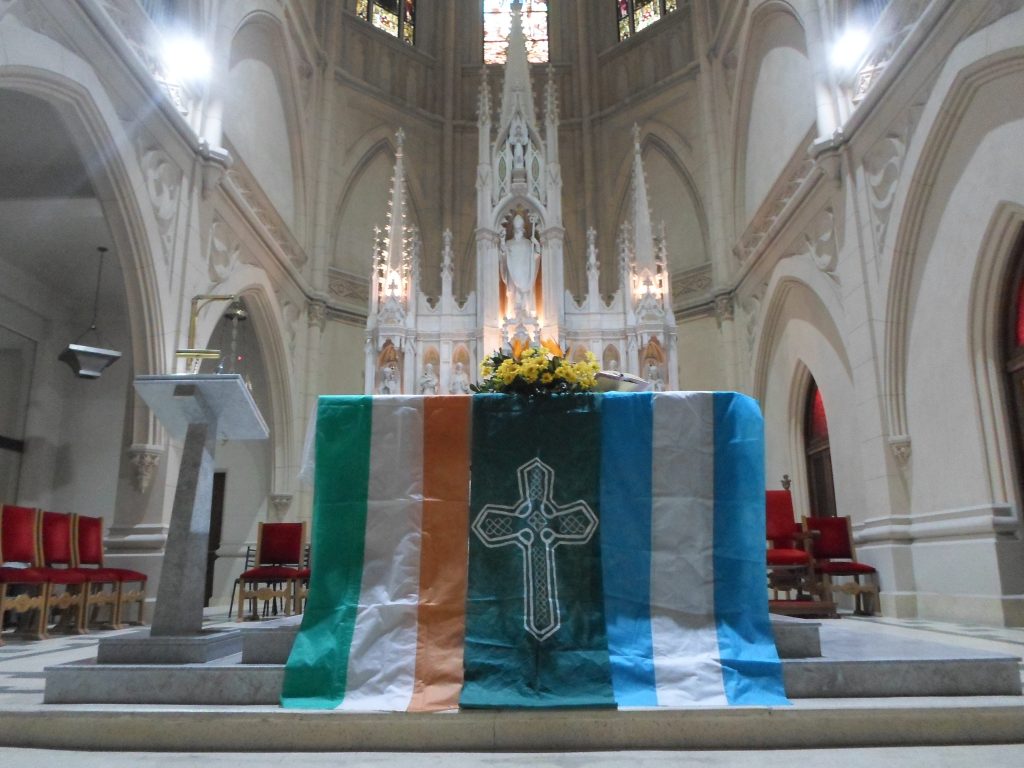
Celebration to mark the 130th anniversary of Colegio San Patricio, Mercedes, Buenos Aires, Sunday 8th October 2017.
It is a pleasure to greet the Archbishop, Msgr Augustin Radrizzani, the civil authorities present, and you my dear brothers and sisters in faith. We are gathered here today in Christian faith and hope as we give thanks to God for all his graces and gifts in this celebration of the 130 years since the arrival of the Pallottines in Mercedes in 1886 and the beginning of Pallottine education in Colegio San Patricio in the month of February 1887.
On Wednesday last I travelled from the present Provincial House in Dublin to Mercedes, the journey lasted a total of 25 hours between departure from the Provincial House and arrival in Mercedes, and I travelled very comfortably. As I travelled I could not but think of those Pallottine pioneers who left their country for the first time in 1885 and journeyed for six weeks in a boat and then several more days from the port of Buenos Aires before arriving in Mercedes. Men of faith and with a spirit of adventure, Fathers William Whitmee, Joseph Bannin and Bernard Feeney, men who followed the missionary impetus of our Founder St Vincent Pallotti and came here to Mercedes where they met with the Irish Community Chaplain, Msgr Samuel O’Reilly, who encouraged them to accept the offer of a small school which a group of Irish Sisters of Mercy had opened, and then closed after a few years.
Fr Whitmee recommended to the Rector General of that time, Fr Faa di Bruno, that this missionary offer be accepted and a decision was taken without much delay and with trust in Divine Province, and it was thus that the first three Pallottines who formed the original community, Fathers Bernard Feeney and John Petty and Brother John Dolan, settled here in Mercedes in September 1886. The Irish Community of the zone made a collection and contributed to the cost of repairing the buildings; for a number of years the school and house were rented and in 1890, with a bank loan, the Pallottines bought them from the Sisters of Mercy.
The Colegio San Patricio, or, St Patrick’s School, dedicated to the Patron of Ireland, opened its doors once again to students at the end of February 1887. And, with the same spirit of faith and with steadfast hope in the Providence of God, we Pallottines have continued with the mission of education which was entrusted to us 130 years ago. We built this beloved school on the foundations which were laid by successive generations of communities of Pallottines. Communities of Pallottines priests and brothers, and communities of Pallottines both male and female, because the school and the commitment to the mission to education have been a joint undertaking of generations of teachers and auxiliary personnel of both sexes, men and women who made their own the Pallottine charism and gave the very best of themselves in this service to the local community and to the Church.
In a spirit of profound gratitude and appreciation we give thanks today to God for those Pallottine pioneers and for each and every one of the persons who were part of the School from February 1887 up to the present.
It would be impossible for me to list the names of the persons who built this Pallottine spirit in Mercedes from the beginning; I am sure that in the minds and hearts of all of us who are gathered here today there is a procession of faces, images and names of those persons whom we knew and who are part of our own special memories. Let us take a moment to remember them in silence and give thanks for them. Today, in the name of the Irish Province of the Pallottines, I wish to congratulate the present community, Fr Tom O’Donnell, the Rector and Parish Priest, Fr Johnny Sweeney, the assistant, Fr Juan Sebastian Velasco, the Provincial Delegate, the Legal Representatives, Fr Fernando Bello, Ms Nenin Filippi and Mr Julio Campora, Mr Alfredo Abalo, Director of the Secondary School, Mrs Alicia D’Angelo, Director of the Primary School, Ms Alejandra Cancela, Director of the Kindergarten, and each person who is part of this beloved community.
Earlier I mentioned that the Provincial House of the Irish Province is in Dublin, however the seat of the Province was here in Argentina from the foundation of the Province up until 1926 when it was transferred to London; and so I assure you that Argentina and the large Pallottine community in this blessed country, forms a very significant part of our Province.
It is an honour for me to be here with you and to greet you on this historic day and I pray to God that he will continue to accompany and guide the present community which is educating another generation and all the future generations which will become part of the education community of San Patricio.
With St Vincent Pallotti let us pray to the Lord of the harvest that he continue to send labourers into the harvest; and let us pray to Mary Queen of Apostles, our Patroness, and ask that she accompany us with her maternal love.
Fr Derry Murphy, SAC,
Provincial Rector.
Celebración de los 130 años del Colegio San Patricio, Mercedes, Buenos Aires; domingo 8 de Octubre 2017.
Querido Arzobispo Monseñor Agustín, estimadas autoridades, queridos hermanos y hermanas en la fe, estamos reunidos hoy en un clima de fe y de esperanza cristiana, agradeciéndole a Dios por todas sus gracias y dones en esta celebración de los 130 años desde la llegada de los Palotinos a Mercedes en 1886, y el inicio dado a la educación palotina en este querido Colegio San Patricio, en el mes de Febrero 1887.
El miércoles pasado viajé desde la sede provincial actual en Dublín a Mercedes, el tiempo del viaje, desde que dejé la casa provincial hasta llegar a Mercedes era de unos 25 horas y viajé muy cómodamente, y no pude no pensar en los pioneros palotinos que, dejando su tierra, pisaron tierra Argentina por primera vez en 1885 después de unas seis semanas arriba de un barco y no sé cuántos días más para llegar a Mercedes desde el puerto. Hombres de fe, y de un espíritu de aventura, los Padres Guillermo Whitmee, Jose Bannin y Bernardo Feeney, que siguiendo el impulso misionera de nuestro fundador San Vicente Pallotti, llegaron acá a Mercedes; y acá se encontraron con el Capellán Irlandés, Padre Samuel O’Reilly, que les incentivó a tomar posesión de la pequeña escuela que habían empezada unas Hermanas de la Misericordia irlandesas para luego cederla.
El Padre Whitmee recomendó al Rector General del entonces, P. Faa di Bruno, la aceptación de la oferta misionera y la decisión fue tomada con fe en la Divina Providencia, y así los primeros tres palotinos que formaron la comunidad inicial, el P. Bernardo Feeney, P. Juan Petty y el Hermano Juan Dolan, se radicaron acá en Septiembre del 1886 y la comunidad irlandesa de la zona recolectó fondos para reparar los edificios, que fueron alquilados al comienzo para después ser comprada por los Palotinos en 1890 con un préstamo bancario, los edificios eran de la propiedad de las Hermanas de la Misericordia.
El Colegio San Patricio, dedicado al Santo Patrono de Irlanda, abrió sus puertas nuevamente a los alumnos al final del mes de Febrero en 1887. Y con el mismo espíritu de fe y de firme esperanza en la Providencia de Dios, los palotinos hemos continuado con la misión educativa que nos fue confiada 130 años atrás. Construimos el querido colegio sobre las bases que fueron poniendo sucesivos comunidades de Palotinos y Palotinas, porque el colegio y la misión educativa desarrollada en él, fueron llevados adelante por los religiosos de la comunidad y generaciones de docentes y personal auxiliar de ambos sexos que hicieron suyo el carisma palotino y dieron lo mejor de sí en este servicio a la comunidad y a la Iglesia.
Con un espíritu de profundo agradecimiento y reconocimiento demos gracias hoy a Dios, por los pioneros palotinos, y por todas y por cada uno de las personas que integraron el Colegio desde Febrero 1887 hasta el presente.
No podría nombrar a cada una de las personas que construyeron ese espíritu Palotino en Mercedes desde los comienzos; seguramente en las mentes y los corazones de todos los que estamos aquí se están dibujando las imágenes y los nombres de aquellas personas que conocimos y son parte de recuerdos especiales. Hoy en modo particular quiero, en el nombre de la Provincia Irlandesa de los Palotinos, felicitar toda la comunidad actual y en especial al P Tomas O’Donnell, Rector de la Comunidad y Párroco, P. Johnny Sweeney, el asistente, P. Juan Sebastian Velasco, Delegado Provincial, a los Representantes Legales, P. Fernando Bello, la Señorita Nenin Filippi, y el Señor Julio Campora; al Señor Alfredo Abalo, Rector de la Sección Secundaria, la Señora Alicia D’Angelo, directora de la Sección Primaria, y la Señorita Alejandra Cancela, directora de la Sección Inicial, el Jardín de Infantes y cada persona que integra esta querida comunidad.
Les dije al inicio que la sede actual de la Provincia Irlandesa es en Dublín, pero la sede provincial estuvo aquí en Argentina desde la fundación de la Provincia hasta que fue trasladada a Londres en el año 1926; y con esto les digo que Argentina, y la comunidad palotina grande en este bendito país, forma una parte muy significativa de nuestra Provincia.
Es un honor para mí poder saludarlos a ustedes en este día histórico y ruego a Dios para que siga acompañando y guiando la comunidad educativa actual y las futuras generaciones que formarán parte de la comunidad educativa San Patricio.
Con San Vicente Pallotti roguemos al Señor de la mies para que envíe trabajadores a su mies; y pidámosle a María Reina de los Apóstoles, nuestra patrona, que nos acompañe con su amor maternal.
Asi sea.
Rector Provincial.
I’m wearing vestments that were made for my predecessor Fr. Seamus who was a much, much bigger man than me by a long shot, so there’s no way I can fill them as he did. There is no way that I can fill the space occupied by him when he was Parish Priest. But all the same the vestments fit me in a different kind of way. Something of Seamus remains here but things are not the same. His death brought an unexpected change and I have become part of that change. When I was his novice master I never dreamed that he would die before me, never thought that I would succeed him.
On the front and back of my chausible is the Pallottine seal with the motto “Caritas Christi Urget Nos” (The Love of Christ Urges us on). This seal is testament to our communal calling, the mission given to each of us personally and together as community.
The emotion of his passing is still strong! He is very much missed and was greatly loved here in Hastings. He touched people’s lives for the better. People tell me all the time, though I don’t think they expect me to do things as he did and I’m not putting myself under pressure to be like him. At 62 you realize that you can’t be what you’re not. I know my limitations, my unworthiness. I know that at some levels of my life I am not fit for this. But I also know the gifts that God has given me. Shankill has shown them to me, taught me how to use them.
Deacon Duncan knows I don’t care for the glory of the big occasion and in the lead-up to my induction as Parish Priest I was fairly apprehensive. I would have preferred if it could have been done in the privacy of the Bishop’s office. But Bishop Richard likes to do it in public with the parish present and Duncan is delighted because he too knows that it’s needed.
They are right of course. Becoming Parish Priest is not a private matter between the Bishop and myself. I belong to the People; we belong to each other in this ministry.
THE APOSTOLATE OF ELIZABETH SANNA
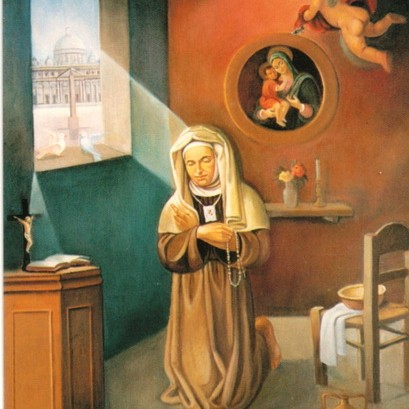 Elizabeth, from a young age, wanted to direct all that she had and all that she would do to the glory of God and to the good of her neighbour. This attitude of hers deepened further under the spiritual guidance of Saint Vincent Pallotti and her life became a conscious participation in the apostolate of the Church which, according to Pallotti means to do what each person can and has to do for the greater glory of God, and for his/her own eternal salvation and that of the other person. All the good that was achieved by her: her prayers, her sufferings, her charitable service, the good advice and counsel given to her fellow human beings and other good things, all of these had an apostolic character. It is worth our while underlining at least some of the activities in a particular way. The prayers of Elizabeth had an apostolic character. She prayed for all the necessities of those who were most in need, above all, for the sick and for the dead, having an immense desire in her heart that all would be saved. And as Fr. Raphael Melia says, “she cried for the unhappy state of sinners, of infidels and of idolaters, that all of them would be finished with sin and that all would return to the bosom of Holy Mother Church”, and so all would be saved. From 1836 onwards, she took part in the Octave of the Epiphany, organized by Saint Vincent Pallotti, encouraging others to participate also and to pray.
Elizabeth’s sufferings had an apostolic character to them, and her sufferings were many. Some, no doubt, were attributable to her inability to return to her family. Other sufferings were on account of her illnesses as well as the oppression of the devil. She offered up all these together with her prayers and penitential practices as expiation for sins and to implore the salvation of all. Following the example of Pallotti, she prayed often and also offered her sufferings for the unity of Christians so that the whole world would be one fold and under one Shepherd.
One can say that Pallotti considered Sanna to be a sick person, a poor person, illiterate, and a saint who lived for the apostolate: the apostolate of prayer, of charity, of poverty, of suffering and, above all, of the imitation of Christ and of the Infinite Love of God.
The apostolic message of Blessed Elizabeth can be summed up in her desire, manifested to her spiritual director in the following words: “I want Heaven to be filled, Purgatory to be emptied and Hell to be closed”.
Blessed Elizabeth Sanna, pray for us.
