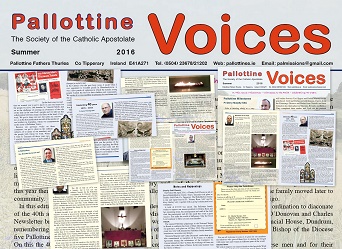
The current Mission Newsletter Pallottine Voices, Summer 2016 can be accessed by clicking on the image below:
Category Archives: ARTICLES
Homily for the Ordination of Deacons June 6, 2016 – Bishop Freeman SAC
Status
HOMILY
Dear Sisters and Brothers in Christ,
“We must always place our trust in the Lord and allow his love to urge us on. “For the love of Christ urges us on, because we are convinced that one has died for all;” Cor. 5:14.
What a joy it is for me to join with you this afternoon in Pallotti House, Dundrum, to celebrate the Ordination to the Deaconate of Liam O’Donovan and Charles Lafferty, who come before us to be raised to the Order of Deacons. We must consider carefully the ministry to which they are to be promoted.
Liam and Charles will draw new strength from the gift of the Holy Spirit. They will help the Provincial and his body of priests as Ministers of the Word, of the Altar, and of Charity. They will make themselves servants of all. As ministers of the altar, Liam and Charles will proclaim the Gospel, prepare the sacrifice, and give the Lord’s body and blood to the community of believers.
It will also be their duty, at the Provincial’s discretion, to bring God’s word to believer and unbeliever alike, to preside over public prayer, to baptise, to assist at marriages and bless them, to give viaticum to the dying, and to lead the rites of burial. Once they are consecrated by the laying on of hands that comes to us from the apostles and is bound more closely to the altar, they will perform works of charity in the name of their Superior. From the way they go about these duties, may you recognise them as disciples of Jesus, who came to serve, not to be served. Priests and Deacons are called to serve, not to be served. We as priests must never lose sight of our calling – we are called to serve the people of God.
The Holy Father recently spoke of the “Seven Pillars” of Priesthood. He said:
- The strength of a priest depends on his relationship with God.
- The priest must be close to the people he serves.
- A priest’s authority must be linked to service, especially to the care and protection of the poorest, weakest, the least important and most easily forgotten.
- The priest must be a minister of mercy.
- The priest is called to simplicity of life.
- The priest must be a model of integrity.
- The priest must be a source of blessing for his people.
Liam and Charles, if you embrace these “Seven Pillars” of priesthood in your service as deacons, and God willing, in your service as priests, your own lives and the lives of the people of God entrusted to your care will become even greater enriched by the experience.
The theme chosen by Pope Francis for this Extraordinary Jubilee Year of Mercy which began on 8th December last, the Feast of the Immaculate Conception, is “Be merciful like the father” from the Gospel of Luke. Scripture invites us to follow the merciful example of the Father “Judge not and you will not be judged, condemn not and you will not be condemned, forgive, and you will be forgiven.“ Luke 6:36.
The logo chosen by Pope Francis for the Extraordinary Jubilee Year of Mercy, which is on the vestment I am wearing this afternoon is that of the Good Shepherd – the Good Samaritan. In the Gospel, the parable of the Good Samaritan speaks of a man assaulted and left half dead at the side of the road. People pass by him and look at him. But they do not stop, they just continue on their journey, indifferent to him: it is none of their business! How often do we say: it’s not my problem! How often do we turn the other way and pretend not to see! Only a Samaritan, a stranger, sees him, stops, lifts him up, takes him by the hand, and cares for him (cf. Lk 10:29-35). We must do our very best to be that good Samaritan, to look out for one another, to care for one another. I believe each one of us has a call to make the world a better place and if each of us can make a difference in just one person’s life – and help that person on their journey – we will be doing as the good Lord asks of us – we will be that Good Samaritan. Indeed, it is in giving that we receive.
In the words of Emeritus Pope Benedict: “Our lives are involved with one another, through innumerable interactions they are linked together. No one lives alone. No one sins alone. No one is saved alone. The lives of others continually spill over into mine: in what I think, say, do and achieve. And conversely, my life spills over into that of others: for better and for worse.” (Spe Salvi, 48).
Liam and Charles, you are being raised to the Order of Deacons. The Lord has set an example for you to follow. As deacons you will serve Jesus Christ, who was known among his disciples as the one who served others. Do the will of God generously. Serve God and humankind in love and joy. Look upon all unchastity and avarice as worship of false gods; for no one can serve two masters.
Like the men the apostles chose for works of charity, you should be men of good reputation, filled with wisdom and the Holy Spirit. Show before God and humankind that you are above every suspicion of blame, a true minister of Christ and of God’s mysteries, a man firmly rooted in faith. Never turn away from the hope which the Gospel offers; now you must not only listen to God’s word but also preach it. Hold the mystery of faith with a clear conscience. Express in action what you proclaim by word of mouth. Then the people of Christ, brought to life by the Spirit, will be an offering God accepts. On the last day, when you go to meet the Lord, you will hear him say: “Well done, good and faithful servant, enter into the joy of your Lord.”
It is not the easiest time to be a priest or deacon, but it is not the worst of times. Being a priest or Deacon can be challenging, but nothing that is worthwhile in life comes easy, quite often life can be a challenge and a challenge can teach us something too. Each of us has our own personal struggles in life – our own personal challenges – nothing in life that is of such goodness comes easy. A life of service requires on-going dedication, commitment, perseverance and renewal. When we apply these wonderful virtues in our lives we can achieve what can often appear to be – the impossible. Change can be difficult. However, to quote a famous priest and prophet from the 19th Century, Cardinal John Henry Newman, “To grow is to change and to mature is to have changed many times.” We must always place our trust in the Lord and allow his love to urge us on. “For the love of Christ urges us on, because we are convinced that one has died for all;” Cor. 5:14.
Our prayer for Liam and Charles today is that the good Lord will bless them with an abundance of all that is good as they begin their service as deacons to the people of God entrusted to their care in the Vineyard of the Lord.
We ask this through Christ our Lord.
+ Séamus Freeman, SAC.,
Bishop of Ossory.
THE MOST HOLY TRINITY
Status
[dt_divider style=”narrow”/]
Proverbs 8:22-31
Wisdom is the first-born of creation
The Lord created me at the beginning of his work, the first of his acts of long ago.
Ages ago I was set up, at the first, before the beginning of the earth.
When there were no depths I was brought forth, when there were no springs abounding with water.
Before the mountains had been shaped, before the hills, I was brought forth ?
when he had not yet made earth and fields, or he world’s first bits of soil.
When he established the heavens, I was there, when he drew a circle on the face of the deep,
when he made firm the skies above, when he established the fountains of the deep,
when he assigned to the sea its limit, so that the waters might not transgress his command, when he marked out the foundations of the earth, then I was beside him, like a master worker; and I was daily his delight, rejoicing before him always, rejoicing in his inhabited world and delighting in the human race.
TODAY YOUR GATE STANDS OPEN: A Moment Of Hope – Eamonn Monson sac
Status
Today your gate stands open,
And all who enter in
Shall find a Father’s welcome
And pardon for their sin.
The past shall be forgotten,
A present joy be given,
A future home be promised,
A glorious crown in heav’n.
Click HERE to read more
Homily: Mary, Queen of Apostles – Knock 14th May 2016. Deacon Brendan McCarrick S.A.C.
Status
A warm welcome to all present here in Knock today, and those who are joining the members of the Pallottine Community and the members of the Union of Catholic Apostolate, as we gather for our annual celebration of “Mary, Queen of Apostles”, our Patroness. It is a great honour for me to be a part of today’s celebration as a Deacon, as I prepare for my Ordination to Priesthood in just over two months’ time. For the last number of years I have sung as part of the choir at this celebration, as well as spending time here in Knock as a pilgrim and worker, learning from those who minister here in our National Shrine.
Mary is known as ‘Queen of Apostles’, since she contributed in her own special way to faith development and its expansion throughout the entire world, by offering encouragement and faith to many people in their times of struggle. It is for this reason that Mary is the model of apostolic activity to everyone in the Church, and most especially to those who contribute to the spreading of the faith in their own way, within our local communities and parishes, with good works known only to God. St Vincent’s Pallotti’s choice of ‘Mary, Queen of Apostles’ as the patroness of his foundation reveals his spiritual relationship with Mary. For St. Vincent, Mary cooperated more than all the apostles in the spreading of the faith, and she has superior qualities over all the apostles.
St. Vincent believed that all members of the Church, and most importantly the members of the Society and Union, would be encouraged by Mary’s example, by seeing in her the most perfect model of true Catholic zeal and perfect charity. St. Vincent held the firm view that all members of his Union and Society can receive from Mary the help they need, through persevering effectively in their apostolate. This vision can also be seen in the great and courageous work carried out in the Book of Judith, expressed in today’s first reading as a prayer (Jdt. 13:22-26).
The Book of Judith is a story which relates God’s deliverance of the Jewish people “by the hand of a woman”. Judith, who was a widow, single-handedly conquered a great army: she overcame her personal struggles in faithfulness to God with a belief that he would protect his chosen people. So strong and so important was Judith, so revered and loved was she, that after her death the People of Israel mourned her for seven days. Through the hand of Judith we are reminded of the “hand” of God first seen in Exodus, and the ‘handmaid of the Lord,’ Mary, in the New Testament account of her acceptance of God’s word – “Here am I, the servant of the Lord; let it be with me according to your word.” (Lk 1:38). This statement from Mary is a summary of her entire life, which was a constant and quiet yes to God, and by her ‘yes’ Mary is recognised by the Church as ‘Queen of Apostles,’ without having any power or office. In this manner Mary is a sign for all faithful members of the Church, and for all members of the Society and Union of Catholic Apostolate, to be apostles in a genuine sense.
Today’s other readings focused on passages that were close to the heart of St Vincent, the scriptural narratives of the upper room (Acts 1:12-14; 2:1-4), and the gathering of Mary and John at Calvary (Jn. 19:25-27). These passages set the tone for St. Vincent’s teaching on Mary as the ‘Mother of all’ and ‘Queen of Apostles’. Throughout his life St. Vincent associated Mary very closely with the passion and death of her son, to remind us of her association with our redemption and her central role in the work of salvation. As 20th and 21st century children of God, we are guided by Mary, Queen of Apostles so that we can achieve the apostolic goals of the Church and St Vincent, to constantly offer God’s infinite, immense and incompressible love and mercy, generously to those we encounter each day.
The words of Jesus in today’s gospel “Woman, this is your son” and his words to John “This is your mother” captivated St Vincent, by demonstrating to him Mary’s constant love for those who love her son, and the love the Church has for his mother. According to St Vincent, these words of Jesus “made us all sons and daughters of His most holy Mother,” and as children of Mary and the Church we are called to listen to those who guide us; to listen deeply within our hearts, like the many witnesses who were present here in Knock in August 1879, and all those who have attended this Shrine since that day.
Pope John XXIII was of the view that Knock is one of the most precious Marian apparitions of the Church, as it contains the entire message of the Church; Mary is a significant and integral part of the message, directing people to the centre of our faith – Jesus, the Lamb of God, who takes away the sins of the world. When the apparition occurred, just a few feet away from where I now stand; Mary offered to the people of that time a new hope and a direction, a hope which constantly assists people through difficult and joyful occasions of their life. This new hope and direction, offered by Mary is constantly available here, and for this reason Knock is alive and active each day; offering love, joy peace and mercy to the many people who attend this Shrine during this year of Mercy and beyond; people from all over the world, made in the image and likeness of God.
For this reason, it is easy to explain why millions of people have attended Knock over the last 137 years, and while here they have found hope, joy and an ability to persevere in their faith, knowing that they are constantly supported by the Mother of God. During the apparition, which lasted over two hours as rain poured down upon all present, no words needed to be spoken, as Christ the Lamb of God was present as the centre of all that was occurring. Faithfully looking at the fullness of the Church’s message was Joseph, who during his life on earth listened to God and protected the Holy Family, and beside Mary was St. John the Evangelist, holding God’s word, a resource which nourishes us each day.
By spending time here in Knock my faith has been nourished, and I have come to realise the vastness of the Church and our faith, through my many encounters with people of different languages and nationalities; we all celebrate the one faith as first proclaimed by Jesus and the Apostles, through the power of the Holy Spirit first poured upon Mary and all the followers of Christ in the Upper Room as outlined in our reading from the Acts of the Apostles.
A number of years ago I was present at a modern day upper room experience; sixty-four different nationalities each with their own language, dance and flag, celebrated together the Feast of Pentecost. As a faith community we gathered in prayer, united with the Holy Spirit, working for the good of the other, like all present at the first Pentecost event, we were sustained by the Virgin Mary, who without preaching the Gospel, became the ‘Queen of Apostles’ through the effectiveness of her prayers. Mary who sustained the courage of the apostles and helped them to prosper in their work, continues this work each day, assisting all who place their trust in God.
As we prepare for the feast of Pentecost tomorrow, it is important to remember that God’s outpouring of the Holy Spirit is not confined to Confirmation Day. As followers of Christ we rejoice that through the power of the Holy Spirit, and the gift of languages, God’s message is constantly being proclaimed all over the world, in schools, Churches and family homes by baptised members of the faith.
Pentecost Sunday each year is a gentle rem
inder to us of the many gifts we have received from God, and this special day assists us in reflecting on “how am I using the many gifts I have received,” the gifts of love, wisdom, understanding and right-judgement. As current day apostles and followers of Christ, we are called to be engaged in the spreading of the kingdom of God by taking example from the Church and Mary, who carried out her apostolate in her own special way. This method of each person being able to carry out their special apostolate was very important to St. Vincent as noted in his writings where he states “Everyone … can acquire the rewards of the apostolate … even if all that they can do is to pray … because God judges the perfection and values of the work of his creature according to the intentions of their hearts.”
Mary who accompanied the first disciple’s in their mission, faithfully accompanies us in our apostolic activity each day. In this way, Mary is a perfect model for all apostolate activity within the Church, she journeys with us, giving us strength, as we answer the call to be an apostle of Christ, in our own way.
I REMEMBER YOU: Pentecost Sunday Morning – Eamonn Monson sac
Status
It’s Pentecost Sunday morning and I feel like I’m a defeated, deflated cartoon character being dragged along by life, despite the fact that I have had a fantastic week in Disneyland Paris. An uncertain sadness has held me in its grip for many weeks now. It refuses to release me and I seem to be powerless to shake it off and, with the best of intentions, no one can take it from me. It holds me in resolute solitude and my heart utters the sentiments of Psalm 13, “How long must I struggle with anguish in my soul, with sorrow in my heart day and night?”
Perhaps it is not my own personal sorrow and maybe it’s vicarious. It roughly dates back to the death of two year old Heidi, to the fact that she is the second child to be taken from her parents in the space of two months – they now have one child left.
I feel something of their desolation, their fear – and I have no answer for the questions that people are asking about God in all of this. The priest in confession a couple of weeks ago said I should thank God that I don’t have the answers because, in truth, the only thing I can offer is presence – my own presence and the presence of God within me. Maybe I can be a reminder to them that God is still with them despite all the evidence to the contrary.
I feel like I don’t know God anymore. Not that I don’t believe in Him – I believe very strongly – but it is faith in darkness, the faith of one who has become “a worm and no man” (Psalm 22).
In this state I am fully ripe for Pentecost! It is to such situations that Jesus comes. He enters again through the locked doors of my heart, through my resistence, my confusion and my fear.
I have to make deliberate efforts to dispose myself to the approach of Jesus and the breath of the Spirit that He brings. I have to counter the darkness with light – positive thought and positive action.
So I have come out into the back garden where the sun shines brightly, a gentle breeze blows around me and a lone robin sings to the silence.
Here I am reminded! The promise of Jesus is that the Holy Spirit “will remind you of all that I have said to you” (John 14:26)
What the Holy Spirit reminds us of on this day of Pentecost is that we are children of God, praying the prayer of the children of the Kingdom in our hearts, crying out “Abba Father!” (Romans 8) And for Pentecost to happen again, to receive new life in the Spirit I must turn to the child within me, the child that I am! All of us need to become little children in order to receive what God is offering. “If only you knew what God is offering you and who it is that is speaking to you!” (John 4:10)
Childhood came to me in Disneyland and suspended my sorrow – especially observing and sharing the experiences of my two young nieces – Katie and Laura, through whom God has been teaching me for the past eight years!
They were queueing to meet and get the autographs of two Disney characters but just when the girls got to the head of the queue the two characters went off for their lunch. We were so disappointed until we saw the head of Peter Pan peeping over the rocks. Then out he came with captain Hook and Katie and Laura were the first to meet them. Captain Hook took a shine to Laura who later said that she likes the baddies while Katie likes the nice ones!!! This was borne out a while later when Jafar beckoned to Laura with his index finger!
Peter Pan was wonderful with both girls and gave them plenty of time. He sensed a certain shyness in Katie and so he took her by the hand while they posed for photos. I think Katie was smitten!
In the evening we watched the parade, wonderful in its colour, beauty and happiness. As Peter Pan’s float was passing he looked down to where we were standing, pointed his finger at the girls and said “I remember you!” and he blew them a kiss! I was overcome with emotional joy!
So now Peter Pan has become a reminder! A reminder of what God is doing and saying in our time. It is God who points to us saying “I remember you! I see you and take notice of you!” It is God in Jesus who blows to us the kiss of the Holy Spirit, breathing the breath of new life into us, taking the hand of our timidity into His own hand. “I am the LORD your God who takes hold of your right hand and says to you, Do not fear; I will help you.” (Isaiah 41:13)
On the first Pentecost the Holy Spirit gave each person the power to speak (Acts 2), the power to express themselves; transforming their timidity into courage; giving them a new and powerful way of expressing themselves, expressing the Good News of Jesus.
It is the same Holy Spirit today who gives expression to the reality that we are right now. Every flame that is brought to the altar is an expression of the community that we belong to – an expresson of who we are as gifted individuals and as part of our particular group or community.
The Holy Spirit also seeks to lead us to new and more powerful ways of expressing who we are and who God is among us; how we can best serve each other as we move forward. It means we need to have the willingness to let go of our resistence and allow the Spirit to do what is necessary in us. In the words of the Sequence, “Heal our wounds, our strength renew, On our dryness pour thy dew, Wash the stains of guilt away: Bend the stubborn heart and will Melt the frozen, warm the chill Guide the steps that go astray.”
“Spirit of the living God fall afresh on us!”
Feast of Mary Queen of Apostles and Pentecost
Status
We celebrate on Saturday 14th the feast day of our Patroness and it is good to recall some words of St. Vincent Pallotti, he wrote “Both the Union of Catholic Apostolate and the community of the priests and brothers were founded under the special protection of Blessed Mary, Queen of Apostles.
Through her most powerful intercession Mary asks for the graces, gifts and mercies that each one needs.”
As we celebrate this day let us commit ourselves to asking Mary to intercedes for us, that we ourselves and all the members of our Province, may receive the graces, gifts and mercies which each of us is in need of at this time.
On Sunday we celebrate the Feast of Pentecost and in the Gospel we will proclaim the words of Jesus “Peace be with you”, words of forgiveness and consolation he directed to the apostles who had left him alone in his passion. Jesus then breathed on them and sent them out to continue his mission, to be instruments of mercy and reconciliation in the world.
In this Jubilee Year of Mercy we know that the Mercy of God is his power to transform our world and we are co-operators with him bringing peace, forgiveness and above all mercy, the infinite mercy of God to others.
In the Bull of Indiction Pope Francis refers to God’s nature as “Patient and merciful”; may we be patient and merciful with all those with whom we come in contact, either in ministry of outside of it.
God bless and happy feast day(s)
Derry Murphy
Provincial
THE ENQUIRING CONSCIENCE IN THE YEAR OF MERCY – Fr. MSURI Emmanuel SAC
Status
THE ENQUIRING CONSCIENCE IN THE YEAR OF MERCY
To pose a question, to seek clarity and to enrich oneself with proper and adequate information is being human and part of our inner desire. Not only do we seek new knowledge about others and about things but, depending on how the questions are raised and manner in which we journey to true knowledge we also acquire an understanding about the self. The choice of information, the times and moments of self-questioning, the sincerity and how deeply we reach inside ourselves will insightfully help in self-understanding, and in navigating the dimensions of our being and our perspectives.
Thus the success of joyfully living enquiring moments is to first establish good will and the right reason as a way of discerning our habits of conscience, mind and will itself. We journey through different experiences as we seek right understanding and right judgment to «do good and avoid evil» which Gaudium et spes and the Catechism speak of as the adage of our conscience. This is a call to a life of good moral and spiritual deeds that are formed and informed by the desire of good formation and knowledge for the authentic development of the corpore et anima unus (body and soul) in all aspects of relationships. Hence a good moral and spiritual conscience is the platform, the ground and foundation of real encounter between our humanity, fragility and desire, and the gracious omnipresence of God and divine gifts.
The supposed ever-present good quality of conscience, formed and informed with knowledge and values, immersed in love and mercy, is an ongoing moral-spiritual project. It constantly reflects on the gracious loving presence of God, seeking growth and development, journeying to become better because it has the presence, reference and authority of the Creator (Ps 32,7; 139,7-12). The fidelity, wisdom and love «deep within one’s conscience» are the foundation of being in touch with the divine law, the discovery of the «divine voice» that calls to love, to authenticity and mercy, responding to values and to «solidarietatis et caritatis» (solidarity and charity). Our enquiring conscience has to embrace the «most secret core and sanctuary» of the value of our being and conscience in moral upbringing by preserving its dignity and vocation towards values and virtues.
The well-being of our conscience in the Year of Mercy is the re-activation of the path that invokes the tenderness of our life in our moral-spiritual vocation and responsibilities. A true enquiring conscience views itself in the totality of life’s responsibilities that are freely loved and accepted in one’s inner being. Hence our moral and spiritual catechesis, in response to a good conscience, will be of help in two ways:
The first mode of a good and loving conscience is to live the spiritual works of mercy. The energy, the joy and the sense of purpose of conscience invites, appeals and enriches the soul as it longs for truthfulness and goodness. A value oriented conscience, seeking God and in communion and solidarity with others will prompt ways of «admonishing sinners, instructing the uninformed, counseling the doubtful and comforting the sorrowful». A conscientious person responding to his/her vocation and making love a lived reality (cf. 1 Cor 13) «is patient with those in error, forgives offences and prays for the living and the dead». Hence our true and loving enquiring conscience is not at ease with what negates and hinders participation or what does not contribute to the moral and spiritual growth of the person. In the spiritual works of mercy our loving conscience seeks something deeper that is valuable and inspired by the living presence of the Spirit of our Lord.
The journey of a merciful conscience in the realm of the spirit is to encounter the body as the temple of the Holy Spirit (1 Cor 6, 19-20). Human conscience, as the secret core and sanctuary, unites us with the divine, and as it is loving and compassionate unites the spirit and the body in the unfolding of relationship with others. Therefore, the level of growth, the charity and generosity of the conscience will query my involvement in «feeding the hungry, giving drink to the thirsty, clothing the naked, sheltering the homeless, visiting those in prison, comforting the sick and burying of the dead». This loving and merciful conscience opens doors of involvement and participation, contributing to wholeness and healing of both body and soul.
Which self-questioning conscience that pursues good will distance itself from all these when they are part and parcel of the vocation and responsibility of conscience? The place of me alone with my God is not individualistic, solitary, secluded and detached. The enquiring conscience in its truthfulness and goodness is communitarian in character and in dimension, and «in a wonderful manner conscience reveals that law which is fulfilled by love of God and neighbour». This is how the attitudes, feelings, attachments and orientations of this sacred and secret core are proved to be authentic and true before God and expressions of moral and spiritual qualities and values. It is true then that a good, genuine, merciful and loving conscience always goes a step further, crossing the limitations and boundaries of thought because what is in the conscience promises something bigger and greater, that which is true and profound in authentic moral-spiritual growth and development.
The Year of Mercy touches the deepest parts of our consciences. It reminds us of our qualities and strengths, of our vulnerability and fragility, also our human journey both in moral and spiritual responsibility. It calls us to remember that we are creatures created out of love and mercy and called to loving and merciful relationships. It recalls to our consciences the necessarily authentic journey that we are to make, preparing a moral-spiritual environment for the flourishing of our inner selves, our communities and others.
The new awareness of the enquiring conscience in the Year of Mercy leads me to ask myself ‘how far and often have I failed in my vocation of loving good and hating evil’. Has my conscience turned into an evil conscience by doing evil and avoiding good? What is the conversation and plan of my conscience (Ps 36, 1-4): is it avoiding sin, immorality and their occasions? How strong and how weak is God’s voice in my conscience, the voice of living a true desire to seek and do good? How has the secret core and the sanctuary been a place of good, true and loving plans and intentions? Is my conscience walking alone and by itself without reference to authority both divine and moral for truthful guidance? How intentionally and responsively am I scrutinizing what stands in the name of feelings for the sake of goodness?
As we query our right and true ways of moral-spirituality in everyday life, we need the new perspective of a conscience that is oriented to the divine and full of the values of transcendence, deeper conversion and fulfillment. Fidelity to our conscience, the embrace of wisdom and the living of sincere love will lead us to a new awareness of the richness of the status and the role of conscience. The search for, and finding of, the true meaning of conscientious life is to walk with in the never-fading inspiration of truth and love, sharing the joys of values as the way of realizing ones moral-spiritual responsibilities. The search of conscience in the immense mystery of love is to be responsible, turning to the Lord of Mercy as the foundation for higher values.
The yearning of the enquiring conscience in conversion is to come back to the sense of our being and the sense of true conscience (Lk 15,17a). One has to remember that God’s goodness is such that God his created a wonderful being and the goodness of his conscience is the abundance of goodness that the Father has shared with us. When we squander this shared goodness and turn our consciences into a fountain of evil, we starve the conscience of its values and qualities, abilities and capacities (Lk 15,17b). It is the work of conscience to think of the future as it situates itself in the present struggles or failures and to make a decision for growth and newness by speaking to itself of its state of being (Lk 15, 18-19). Without delay, and not under the influence of the opinions and thoughts of others, it’s time for a courageous and conscious move to a new life experience in the loving and merciful presence of God the Father who embraces all our consciences as we seek new life.
The moral and spiritual journey of an enquiring conscience is to know, love and serve the good-will, it is to know the value and meaning of the immanence and transcendence of life. It is the rediscovering of the khárisma and vocation of the enquiring conscience, moulding it in the love and mercy of God, the Creator and Redeemer. It is taking up again our daily human, moral and spiritual duties attentive to the status and role of our conscience leading to a new outlook and objectivity in view of true and right intention. In the moral and spiritual rebirth we then follow an enquiring conscience that is true, loving, merciful, objective and relational. It is a moral-religious conscience that sticks to true meaning and values, living in generosity the fullness of its adage in caritas.
Thus, a new conscientious and conscious experience in the Year of Mercy that is insightful, growing towards moral and religious conversion has to have the desire and will to raise challenging questions confronting our attitudes, thoughts and behavior. The darker side of our understanding and judgment, of appreciation and living are to be gauged if we are to embrace gracious moments again. Our oblivion to sin, our flight from truth and our clinging to moral and religious ignorance need a new dimension. Our journey now and always is the unfolding of a fundamentally correct, healthy, gracious and holy conscience that is willing to go an extra mile in relational and communal life.
“I sought to hear the voice of God and climbed the topmost steeple, But God declared: “Go down again – I dwell among the people.” (John Henry Newman.)
Fr. MSURI Emmanuel SAC
Heidi
Friday April 22nd is international Earth Day but I’m only vaguely aware of this. There is no space in me now for the wider world because my whole being is focused on the patch of earth in front of me Continue reading Heidi
THE CALL TO COMMUNITY LIFE by Mags Gargan
Status
2016 was a year of celebration for the Pallottine Fathers and Brothers in Ireland. Two of their six students, Charles Lafferty from Co. Derry and Liam O’Donovan from Co. Kilkenny, will be ordained deacons in June and two more, Rev. Brendan McCarrick from Co. Sligo and Rev. Jaimie Twohig from Co. Cork will be ordained priests in July.
“It is a really positive year and there is great elation,” says Fr Emmet O’Hara, vocations director. “I think students attract students, because they see there is life and hope here.”
“It is a great excitement for me and the community, but also for my family and my parish at home,” says Brendan (39).
He began a discernment process for the priesthood back in the 1990s but realised “it wasn’t for me” and worked for a number of years in a concrete manufacturing company. However, the call to a vocation never completely left him and he says it was a desire for community life that drew him to the Pallottines.
“I travelled to World Youth Day with them in 2008 and on that trip I decided that I would like to try and return to religious life, and I was warmly received to journey with Fr Emmet and the Pallottines.”
Living in community has also been an important part of the vocation journey for Jaimie (27).
Community
“I always liked the idea of the support and friendship of community life,” he says. “There is a great bond between all the students and with the other ordained priests and the brothers in the community. They helped us as friends and showed us what community is about. It’s like a family in many ways. It’s not always easy, there are challenges, but I am happier than I have ever felt before.”
Jaimie says he was a typical teenager and faith wasn’t very important to him growing up, but this all changed when he went to Medjugorje at the age of 16.
“The experience over there was life changing. I really found my faith,” he says. “When I left school I worked for three years for a pipe company but this thought of the priesthood was always there. No matter how much I tried to convince myself it was never going to happen, it never went away. So I thought I had to do something about it,” he explains.
“I was discerning for a while and I came across the Pallottines. I started journeying with Emmet and I remember there was one vocations weekend in particular in Thurles and I just knew that this was the right place for me. I felt a great peace and I knew the Lord was calling me there.”
The Pallottines were founded in Rome in the 19th Century by St Vincent Pallotti, who had a desire to revive faith and rekindle charity. “He saw a crisis of faith in his own time,” says Fr Emmet. “Today we are in Rome, Ireland, England, East Africa and North and South America. In Ireland we have a Student House and Provincial House in Dundrum, Dublin and a Retreat Centre in Thurles, Co. Tipperary. We also have two parishes in Dublin, one in Corduff, Blanchardstown and one in Shankill.”
John Regan (40), from Co. Mayo, is in his fifth year as a student with the Pallottines and he believes that he would not have entered religious life if he had not been invited on retreat by a Pallottine Father he met in Medjugorje.
Vocation
“I had a fairly comfortable life, but there was a yearning inside myself and I wasn’t really happy,” he says. “It is important that you have somebody like a vocations director who will ask have you ever thought about a vocation. You have to ask people, encourage them and keep in touch with them,” he says.
Brendan thinks that prayer has a vital role to play in encouraging vocations. His small home parish began an initiative to regularly pray for vocations and now three men from the area are on the road to priesthood.
“I think silence and quietness of heart is also really important in discernment,” Jaimie says. “It’s not that the Lord isn’t calling, but it is so hard to hear in the culture we are living in where there is so much noise and distraction that we don’t listen to our hearts.”
All the students agree that while joining the priesthood may seem like a counter-cultural decision in today’s society, they have received nothing but positive support and encouragement from friends, family and former work colleagues.
“If you are listening to the secular world it will tell you this is very counter-cultural, but the support I have received from so many people was really encouraging. I didn’t think I would get that support,” John says.
Fr Emmet’s advice for anyone out there who is thinking about a vocation to the priesthood or religious life is “don’t be afraid”. “Make that step, get in touch with a vocations director and see where the Holy Spirit might be calling you to. Have the courage to check it out and see where it goes,” he says.
– See more at: http://www.irishcatholic.ie