WELCOME TO PALLOTTINES IRELAND
Pallottine Fathers and Brothers
King, Sr. Regina (Gertie) R.S.H.M. Late of Huntstown, Dublin, Madonna House, Ferrybank and formerly of Drumquin, Silversprings, Co Tipperary November 21st (Peacefully) Predeceased by family who were of many, Sadly missed by her sisters Nora, Alice and Marjorie, brother Harry, sisters-in-law, brother-in-law, nieces, nephews, grandnieces, grandnephews, the Religious of the Sacred Heart Of Mary, relatives and friends.
Rest In Peace
Reposing in the Convent Chapel tomorrow, Monday evening, from 2.30pm until 4.30pm. Removal on Tuesday to the Sacred Heart Church, Ferrybank arriving for Requiem Mass at 12 noon followed by burial in the Community Cemetery.
”Ar dheis Dé go raibh a hanam dilis”
+++
In the Year of Consecrated Life – a special celebration of the work of three congregations: The Trinitarians, the Pallotines and the Religious of the Sacred Heart of Mary – present in the parish for over 30 years in the person of Sr Regina King – was held in Corduff parish.
We welcome today Sr Regina’s community, family members and friends as we publicly acknowledge her contribution to the life of this parish and community… Pope Francis has set aside this year to highlight Consecrated/Religious Life. Of course I will argue that we are ALL consecrated in Baptism but it is also important to recognise the diversity of Religious/Consecrated Life and today especially to publicly thank Regina for her dedication and service to this community, to the parish and to the Church. Pope John Paul 11 in his work on Vita Consecrata stressed the importance of ‘Being’ as opposed to ‘Doing’. Yet if one examines briefly some of the many, many things that Sr Regina has been involved in, and with, during her time here she may be a ccused of ignoring or disobeying the Pope. Resource Centre, development groups, childcare minding, community development projects, Brownies, the Jesus Hour, Senior Citizens, Art Group, sewing co-op, Rainbows, Anam Charadis, annual retreat to Wales, St Vincent de Paul, Parish Choir, Parish Pastoral Council – it is an exhausting list in itself.
But Sr Regina’s ‘Doing’ is part of who she is – it is part and parcel of her ‘Being’. She ENABLES others, EMPOWERS them. In that way she brings alive her Faith and her Congregation’s Motto: ‘that all may have life’ but Regina completes it with the next phrase ‘and have it to the full’.
We thank you today for your service, for your creativity, for your insightfulness, for your life of prayer. We thank you for what you ‘DO’ and will continue to ‘DO; but most importantly we thank you for ‘WHO YOU ARE’
Fr. Liam McClarey SAC PP, Corduff
Taken from RSHM Religious of the Sacred Heart of Mary
My soul is shut out from peace; I have forgotten happiness. And now I say, ‘My strength is gone, that hope which came from the Lord.’ This is what I shall tell my heart, and so recover hope: the favours of the Lord are not all past, his kindnesses are not exhausted; every morning they are renewed; great is his faithfulness. It is good to wait in silence for the Lord to save. (Lamentations 3 – First Reading)
November 15, 2015
Only for God and good people there have been many days in my life when I couldn’t see how I would make it from morning through to day’s end. And only for God alone there have been long nights that I might not have survived. It strikes me now that those nights were possibly the most sacred because of their aloneness and togetherness – God and I alone, God and I together in a way that is not possible at any other time. There are still such days and nights but not as many. Not for such prolonged, drawn-out periods.
I’m thinking these thoughts because yesterday I celebrated the funeral Mass of a man who took his own life. Married with three children and a beautiful wife. They were inseparable.
I have often wanted my life to end. Seriously. But I never thought of taking it myself because I have a solid conviction that all life belongs to God and only He has the right to take it.
I have not contemplated committing suicide but I understand the dark forces that can drive a person to it.
The dead man’s mother has changed her mind about suicide. She used to think it was selfish but now she realizes that something in him must have snapped to make him do what he did. In his right mind he would not even dream of leaving his family behind, of hurting them in the way that they are hurt now.
Only a few days ago I was talking to someone about suicide and whether it’s a selfish act or not. We concluded that it’s not. Something too powerful must overwhelm the person who does it.
Whatever the motive, whatever the unfathomable darkness that stirs within the man, there is no doubting the catastrophic effect on the family left behind. The questions that cannot be answered, the guilt, the anger, the disintegration, destruction – there are not enough words to say how awful it is. They will never fully recover, though we hope for some level of healing.
The life and death of each of us has its influence on others; if we live, we live for the Lord; and if we die, we die for the Lord, so that alive or dead we belong to the Lord. (Romans 14 – Second Reading)
As I stood at the entrance of the church yesterday waiting for the hearse to arrive, I could feel myself absorbing all the distress of this ordeal – the crowd filling the church to overflowing, the crowd outside in the torrential rain. I wonder what can I say to all these people to help make sense of it. So many young people here. I have words prepared but they escape and all I can feel is the fretful distress growing inside, filling every fibre of my being. Not just my own distress but that of all the people, not to mention what will arrive in the immediate family for whom we wait in the cold, wet silence.
Prayer brings me to that place within myself where I go in search of God only to discover that He is searching for me as He searched for Adam and Eve in Eden. He searches in the places where I hide – from Him and from myself. Sometimes the confusion, the disturbance, the inner distress comes from this fact of God searching for me, a searching in which He turns my inner space upside down so that He can uncover me.
“When a man thus enters his interior house in search of God, he finds it all turned upside down, for God it is who is seeking him; and God acts like a man who throws one thing this side and another that side looking for what he has lost. This is what happens in the interior life whena man seeks God there, for there he finds God seeking him…” (Fr. John Tauler OP, 14th centuary)
This is where I find blessing in the deepest confusion of my life and I feel for anyone who cannot make this connection between God and one’s own deepest distress.
This is the spirit in which I celebrate the funeral Mass – in a great silence in which even the crying of the mourners is soundless. Wife, children, parents, sisters, brothers. Friends. All heart broken like the body of Jesus. And I remember my own cousin and his family.
I say to men especially – try to talk about what’s bothering you inside. Women have a natural way of unburdening themselves and maybe this is why 6 out of 7 suicides are men. I know at times that I can’t put words on what I’m feeling but it’s important to try for your own sake and for the sake of those who love you.
It’s important also to find things that give you a connection with the one who has died. At the offertory they bring two kinds of connections – physical and spiritual. The Man united jersey and football boots are physical connections. He has worn these, they have the touch and the smell of him in them. Touching them and smelling them for a while will help the grieving process.
The spiritual connection comes in the form of bread and wine that become the body and blood of Jesus in Holy Communion. When we are connected with Jesus we also have the strongest and most lasting connection with our loved ones who have died, the strongest and most lasting connection with life itself, the life that we are called to live right now. Part of the connection in the Eucharist is with Jesus’ own experience of desolation – the cry “my God, my God why have you forsaken me?” He utters that cry in us in our desolation and he also utters the cry of surrender “into your hands I commend my spirit.”
The cemetery is utterly miserable with rain and every other misery you could think of. It’s as if creation itself groans and cries in mourning. And tired, everyone seems so tired. His wife holding their baby who happily knows nothing of what is taking place. But he has a connection with his Dad, a lovely connection from the moment he was born and the nurse placed him under his Dad’s shirt for warmth. The picture of his little head sticking out under his father’s chin. Something in him will miss and ache for this connection but hopefully the power of the connection will sustain him as he grows up.
The mother of the deceased comes to thank me. She and her husband are battered and bruised by this experience, her husband looks broken. She has a strength that shines through, a thoughtfulness and a generosity in which she says to me “I will pray for you.”
At home I take off my muddied shoes and wet socks. Hot water eases the strain on my face. I know I will be rattled by this for a while but the family will live it constantly for a long time to come and even forever. God help them.
Jesus said to his disciples: ‘Do not let your hearts be troubled. Trust in God still and trust in me. There are many rooms in my Father’s house; if there were not I should have told you. I am going now to prepare a place for you, and after I have gone and prepared you a place, I shall return to take you with me; so that where I am you may be too. (Gospel of John 14)
Fr. Eamonn Monson sac, Shankill

Scripture readings quoted above were chosen by the family for the funeral Mass
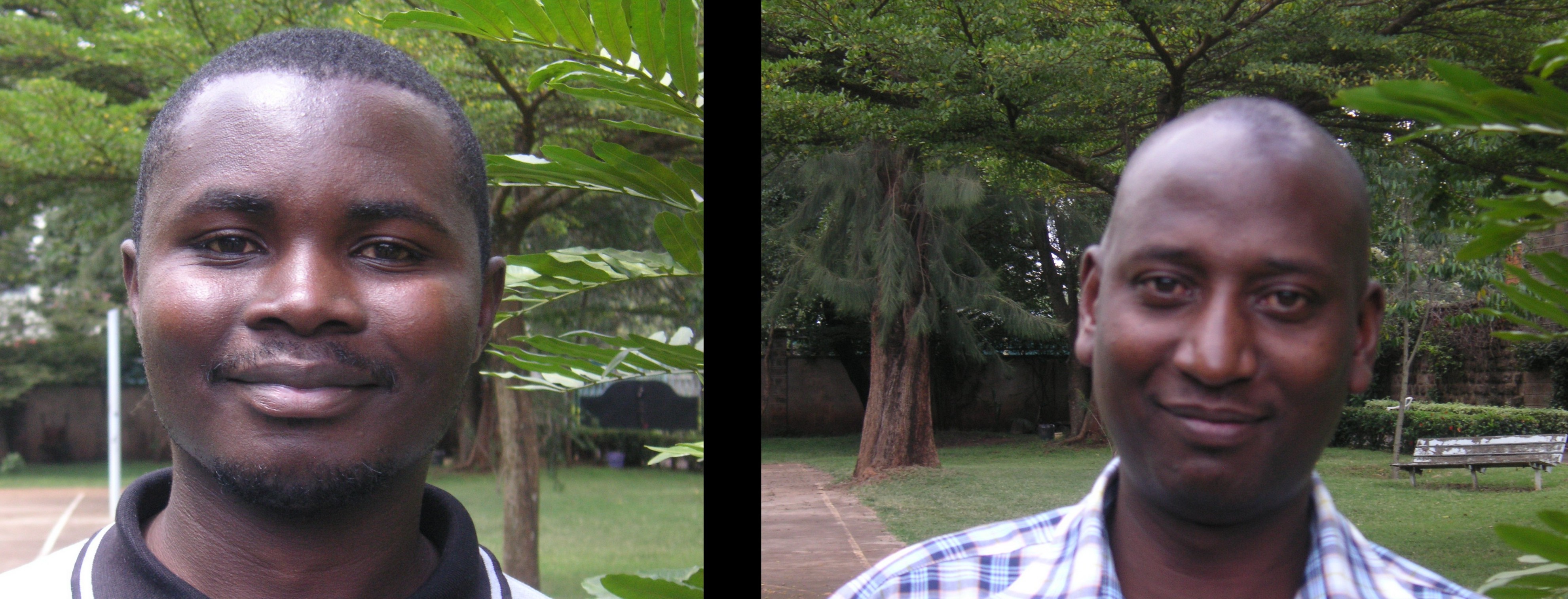
On Sunday Nov 1st. at St Vincent Pallotti Parish, Esso, Arusha. Archbishop Josephat Lebulu will ordain Allan Bukenya SAC (pictured below on the left) and Simon Sserufambi SAC (pictured on the right) to the priesthood. Cyril Ingosi and Dedan Munyinyi will be ordained to the diaconate. Wishing them every blessing and happiness in their ministry. Ad multos annos!
Taken from the Homily given at the funeral of Fiona Perrem, Nazareth Community. With her husband Peter she guided and supported engaged and married couples for more than 40 years. She died suddenly on October 19, 2015. May she rest in peace.
 That the Wedding at Cana takes place on the third day is very significant because it alludes to the day on which Jesus rose from the dead and it points us all, and especially the married couple, in the direction of the resurrection. It is an invitation to new life, to the joy that flows from Jesus himself, the joy of the Holy Trinity.
A couple who are married in the Lord become one body, one Icon of God, a window giving us a glimpse into God; one revelation of who God is and they live the priesthood of Christ in a way that is not lived by the ministerial priesthood – their love for each other is the supreme image of Christ’s love for the Church.
In giving birth to children they reflect the life-giving priesthood of God the Father. A Christian family in turn becomes an Icon and reflection of the family of the most Holy Trinity.
Marriage and family offer us the various expressions of the One Love of God – espousal, fatherhood, motherhood and the childhood – each of which is found in Sacred Scripture.
The Hidden life of the family of Nazareth is seen by St. Vincent Pallotti as one of the most precious aspects of the life of Jesus. The inner family life that is private and not public, a hidden interior life that feeds all that we are and do when we go out the door of our home to school, to work, to play and to minister. What goes on in the privacy of the home, especially a Christian home is very sacred.
Pope Francis in his homily at the conclusion of the Synod on the Family points out that faith cannot be scheduled. Family life, human life cannot be scheduled in the way that we often want or expect it to be. The thrust and tumble, agony and joy, the mess and the tidying, the unpredictability of our home all contribute to its sacredness. God is in the midst of it all with us.
 In a special way the family table is sacred. I love going to visit families where there are children, to sit at table with them and go with the flow of a child’s natural, God-given way of being. It is certainly an image of what we will experience at heavenly banquet – the abundance spoken of in Isaiah, the experience of salvation, the wiping away of every tear and the consolation of every sorrow. The vibrancy and love of parents and children sitting down together is an Icon of the table of the Holy Trinity.
The marriage feast of Cana is a great expression of the table of the Lord in the Eucharist, table of the Word and sacrament, the source of all grace. It is a cenacle discipleship that has Jesus in all His fullness as its centre; a discipleship that includes the central role of the motherhood of Mary who, in the mystery of Divine Providence, is able to bring forward the hour that has not yet come.
It is a mystery which tells us that, in the compassionate gaze of God, the need of the human person, the needs of this one married couple somehow take precedence over the “hour” of God himself. In the life of Jesus everything happens at the proper “hour”, it is the time of fulfilment. Cana reveals the parental love, especially the maternal love that always puts the needs of the child before oneself.
We run out of wine, the joy runs out of our lives and we are left empty like the earthen jars, an emptiness that expresses something of the great longing of the human heart, an emptiness waiting to be filled.
On the word of Jesus each is filled with twenty, thirty gallons of water – an abundance. But water is not what is missing at the wedding, no matter how abundant it is. The wedding needs wine and they are given an abundance of it and not just any wine but better wine. The best!
 And of course Jesus is not just giving new and better wine. He is giving the new life of the Spirit, the transforming life of the Spirit, the transformation that is needed in each particular, unique situation. This is the ‘Cana’ to which every marriage is invited, every family and every solitary person.
There is a sign that Jesus seeks to work in our lives and, if we let Him, then we will see His glory in the ordinary as well as in the miraculous. And by it our faith is strengthened and in believing we are set free.
 Maria Elisabeth Caspar was born on July 7th 1918 in Berschweiler, diocese of Trier, Germany. She was called Liesel, a short form of her name Elisabeth. Later, in Peru, she was called Isabel – the Spanish form of her name.
Until 1930 she attended the local Elementary School and then, for four years, the Grammar School in Saarlouis. Liesel grew up in a deeply religious family. Her own sister was also a Pallottine Missionary Sister of the English Province. Her father, an upright and loyal catholic and headmaster of a school, underwent considerable suffering during the Nazi period.
Liesel felt drawn to missionary life early on. In 1934 she joined the mission school of the Pallottine Sisters in Limburg, and shortly afterwards was sent to the Convent High School, Rochdale, England. She passed her London Matriculation Exam in 1938 and, on October 20th of the same year began her postulancy in Limburg, Germany. On August 16th 1939 she became a novice. She took her first vows on August 17th 1941 and her final ones on August 15th 1947.
Like so many young professed Sisters at the time, she had to help nurse the sick in the hospital that had been established in the mission house of the Pallottines in Limburg. Here she obtained her Nursing Certificate in 1945. After its closure in 1947 Sr Liesel helped in the office of the Sisters’ motherhouse Marienborn, until she joined the staff of their children’s home in Facit, England. When in 1952 staff and children moved to Pallotti Hall, she was transferred there.
In 1956 Sr Liesel returned to Limburg, Germany and soon afterwards was sent to the mission in British Honduras, now Belize. At the time her health deteriorated and in 1963 she had to return to Limburg. A few years later she returned to England.
During her time in England Sr Liesel was able and willing to turn her hand to various ministries. The Pallottines remember her with fondness, for she helped in their college in Thurles, Ireland, and in the Provincial House in Golders Green, London. She was also one of the pioneers who helped get the Westminster Pastoral Centre at London Colney into some form of habitable state.
One of her happiest periods was the time spent in the mission field of Peru. In 1977 she willingly agreed to help a missionary team from the Diocese of Leeds. One of the Sisters of Mercy who worked there fell ill and Sr Liesel “temporarily” took her place. On 23rd of December she arrived in Huambo in the Diocese of Chachapoyas in the Amazonas region.
At first Sr Liesel worked in this isolated and poor area in the Andes. She writes of the village: “It could be a replica of Nazareth or Bethlehem with its living quarters and children, donkeys and horses, with its rough streets and insanitary conditions.” Of her first Christmas in Peru she says: “Christmas is everywhere, also in Huambo. Tonight I shall experience it quite differently. He became poor for the poor, and lived with the poor. It makes me very happy to share some of that poverty with Him in order to help these people find happiness in Him. They are all Catholics of a sort, but full of ignorance and superstitions, helpless and hopeless, because they can’t believe that they can improve things with God’s help and their own efforts. Yet they are friendly, open and affectionate and welcomed me like a miracle. May I not disappoint them.”
She worked very hard in Huambo. Often they had to ride out on donkeys or horses to reach isolated areas where the sick and lonely were waiting for Holy Communion, where children had to be baptised and where the poor waited for comfort. From the beginning she was much involved with catechesis and the formation of catechists. After some years she moved to the episcopal town of Chachapoyas.
 When the team dispersed in 1987, Sr Liesel and Fr Gerry Hanlon, a priest of this missionary team of the Diocese of Leeds, moved into the Cathedral Town of the Apostolic Vicariate of Iquitos. Here Sr Liesel took care of passing missionaries, continued catechesis and preparation of liturgies, was spiritual director of the Legion of Mary, and above all became absorbed with work for street children and drug addicts. Just before her death she had begun begging for money to foster a fishing project, which would enable a number of fathers to make a living for their families. God alone knows the many efforts she made for the poor of the town.
In November 1996, Sr Liesel suffered from a severe pulmonary illness aggravated by embolism. She rallied but still needed medical supervision. In January 1998 she wrote: “I feel well and strong. I take my weekly day off to go into the country and I take it easy.” In the same letter she wrote: “The next big event will be the General Chapter starting in March.” She followed closely the events of her Province and of the Congregation.
Unexpected by the Sisters of her Congregation, she died on 14th April 1998 in Iquitos, where she was buried.
Christine Bohr sac – London – ENGLAND
05.10.15
Fr Gerry Hanlon, on whose invitation Sr Liesel had gone to Peru and with whom she worked most of her time there, remembers her nearly seventeen years later:
Sr Liesel arrived in Huambo, our extremely remote village, on the top of an open truck on Christmas eve 1977.
When I was appointed to Chachapoyas she followed me there and became diocesan bursar, making sure the priests and sisters who came in from their remote parishes, got enough money to live on.
Then, when I moved to Iquitos in the jungle area, she followed me there. We lived in a mission house and said morning prayer together before having her special breakfast. I was involved in education, and she attended Legion of Mary meetings, and monitored all the Masses at the Cathedral. She also bought food and took it out into to the country every Saturday to a drug addiction rehabilitation house.
Needless to say I greatly enjoyed her company and she was extremely kind to me.
Thousands turned out for her funeral, and it was most moving to see ex drug addicts carry her coffin. Their comment was “She was a mother to us all”.
This comment courtesy Sr Adelheid Scheloske sac, archivist for the Pallottine Missionary Sisters, Germany
To be part of a first Christian church.
The members of the delegature of the Irish Province in the Argentine gathered in the retreat centre of Villa del Huerto, Cortinez, in the Province of Buenos Aires on Monday October 12th. The Sisters of the Congregation Nuestra Senora del Huerto (Sisters of Our Lady of the Garden of Gethsemani) welcome the community here most years for the annual retreat and we all feel very much at home in this house. It is a simple house, on nicely kept grounds, but now what was once a secluded spot is just next to a national motorway and the noise of the traffic provides an undernote of movement twenty-four hours a day. It is remarkable that it does not impinge on us after a while and seems to be just a noise in the background.
This year the retreat was animated by Fr. Jorge Oesterheld, of the Diocese of Moron, parish priest of a busy city parish. He focused on what is central to our lives as Christians, the presence and activity of God in our midst and through his presentations led us to reflection. He is a practical man and has ‘the gift of the gab’ but also a very sure turn of phrase and the ability to relate the theme he is speaking on to the concrete realities of life as a priest. An example of his use of the concrete: he invited us today to imagine that we are going to make a journey, to climb a mountain, and we can carry what we need for the journey in a back-pack; on the journey, in climbing the mountain, even an extra toothbrush in the back-pack will take its toll on us. Hence the need to choose carefully what to take for the journey, to focus on what is essential and what will sustain one on the journey of living as a disciple of Jesus Christ and then leave the rest aside and continue the journey.
One of the concepts that he developed struck me and has guided my thinking and praying in these days. In speaking of the early Christian churches he made the point that they were made up of persons who had known Jesus and who had been transformed by that encounter. The next generation was one of persons who encountered persons who had been transformed through their encounter with Jesus and were in turn ‘infected with’ their experience of Jesus. Throughout my life I have often wondered what it would have been like to be part of such a Christian community and have felt that what we are living now is a very watered-down version of what they were. However, Fr Jorge stressed that we, the Christians of today, are part of the first Christian Church because every community, every church is in a true sense a new church, a first Christian church. New and original in that Jesus is present, just as present as he was in the communities in the first, second and third centuries; Jesus related to Peter, to the other apostles, to Mary Magdalene, to Paul, and he continues to relate to you and to me in the same manner today. Therefore we can believe that we, you and I, are part of a first community. Each of us came to know Jesus through the lives of others who had themselves known him through encounter with him; we in turn will pass on our enthusiasm and conviction to others who will seek Jesus.
The same characteristics that identified, formed and sustained the first Christian churches are those that identify, form and sustain us today, the living presence of Jesus, the action of the Holy Spirit, the fact that we gather together with Mary to pray, the trust we have that the Holy Spirit will continue to act in our hearts. And, the means that sustained the first communities are part and parcel of our community today: the gift of faith, a living and breathing faith, the Holy Spirit, enthusiasm for the message of Jesus, being transformed by the experience of Jesus, the presence of the community, the enthusiasm generated by a common experience and conviction, and the celebration of the Eucharist. As members of a Christian community, as disciples, we bring the Gospel to the situations we encounter today in our day-to-day experience. Pope Francis is urging us by word and example to bring the Gospel of Jesus to bear on the experiences and situations of daily life and living; our community will be a ‘First Christian Community’, to the extent that Jesus’s presence and activity is acknowledged accepted and transmitted to others.
If, and it is a big IF, I can realize that I am part of a first Christian community, then I know that the future is uncertain, I cannot predict it nor imagine it, I do not know even if there will be a future or much of a future, but I can trust that the living presence of Jesus continues to give life and meaning and direction to the Community-Church that has lived and grown over two thousand years. I want to be part of that church community.
Derry Murphy, SAC, October 2015.
My nephew is a very good body builder and he invited me to the Mr. Ireland show that he was competing in last Sunday. I’m not all that keen on big muscles, though maybe I’m envious, but I went anyway because I love him. And there I found myself in a big long queue outside the Olympia, easily the oldest and smallest man around.
About an hour into the show my nephew’s group arrived on stage – 23 of them all tanned and oiled in speedos. They did their 35-second routine as a group and out of this group six were chosen to contest the final. When they called my nephew’s name as one of the six I let out an uncharacteristic roar of delight. I was hooked! As he came on to do his solo routine my heart pounded and I trembled for him. And then something happened to me, to my vision, my way of seeing – I no longer saw the muscles, I was no longer observing on the edge. I saw my fine handsome nephew, a young man who has a hard time of it in life, and I was proud of him, rooting for him with my whole being.
And his late mother, my sister, was in the air between us. The audience didn’t know it but I knew that he was doing this for her and I was filled with tears, the stronges of emotions. Love and loss!
I understood that it was no longer me looking at him with my limited vision but it was Love that looked at him, it was God Himself seeing my nephew through me and I was seeing with the eyes of God. There’s an ordinary way of looking at people and life. And there’s a godly way of looking.
This is what Jesus is doing with the young man in today’s gospel. He looks steadily at him and his gaze is filled with love and truth and it is under this beautiful gaze that the man is offered an opportunity to grow and to advance further on the road of Life – the freedom of the children of God. But, sadly, the man did not accept the opportunity offered because it demanded too much of him.
The journey into the fullness of life is very demanding, in the way that an athlete prepares for competition. My nephew gave 16 weeks of rigorous training for last Sunday and I found myself saying that if I put as much effort in building up my soul, then I’d be in great shape altogether. The condition of the soul is infinitely more important than that of the body but we don’t give it the kind of attention necessary for eternal life.
 Our question to Jesus is, “what must I do to build up my soul so that I am fit for Life eternal?” and Jesus gives two answers – one is keep the commandments and the second is that you need to do something more than the commandments ask. He looks at you now with love, sees you with loving eyes and says “you need to do one thing more”.
Ask yourself, what is the one thing, what is the one thing that is blocking your way to fullness of Life, what’s stopping you living the kind of life that Jesus calls you to live?
When confronted by the horrific tragedy of the families in Carrickmines today, we need a Godly way of seeing such tragedies. When a pregnancy doesn’t work out we need a Godly way of seeing, when a loved one is trapped in addiction we need a Godly way of seeing. When faced with a person that I do not like, someone I find difficult to get on with, I pray to see that person as God sees him or her.
In all our struggles we need to learn to see as God sees, to understand as He understands, to Love as He loves and in this to discover hope for our own personal journey and that of other people.
Sunday 28, Mark 10:17-30
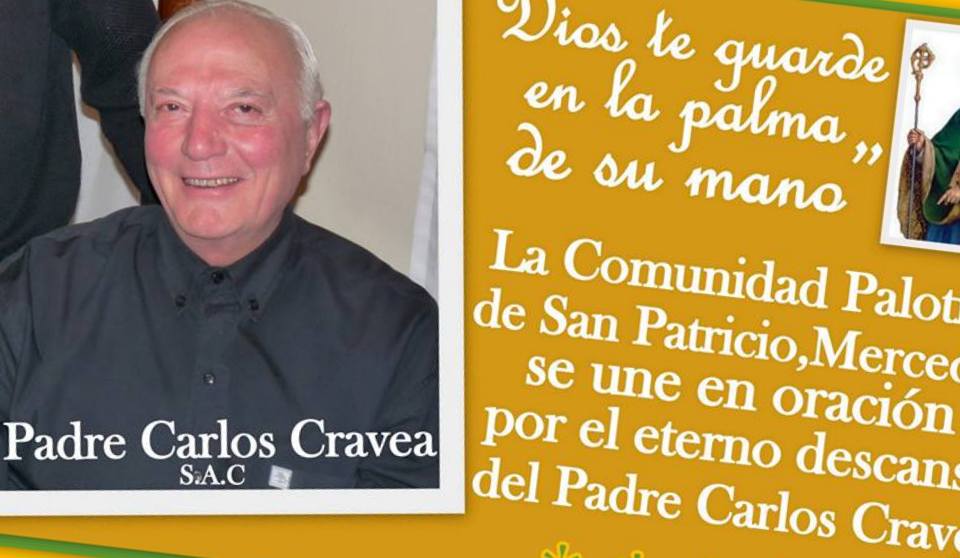
Fr. Juan Sebastian Velasco, Provincial Delegate in Argentina, communicated the sad news of the death of Fr Carlos Cravea last evening. Carlos had been hospitalized in recent months with recurring thrombosis in his legs; he was diagnosed with terminal pancreatic cancer just two weeks ago.
His funeral Mass will be celebrated today in St Patrick’s Church, Belgrano, he will then be taken to Mercedes where there will be a funeral service in St Patrick‘s Church there and then buried in our plot in the municipal cemetery.
May his soul rest in everlasting joy with our Lord.