
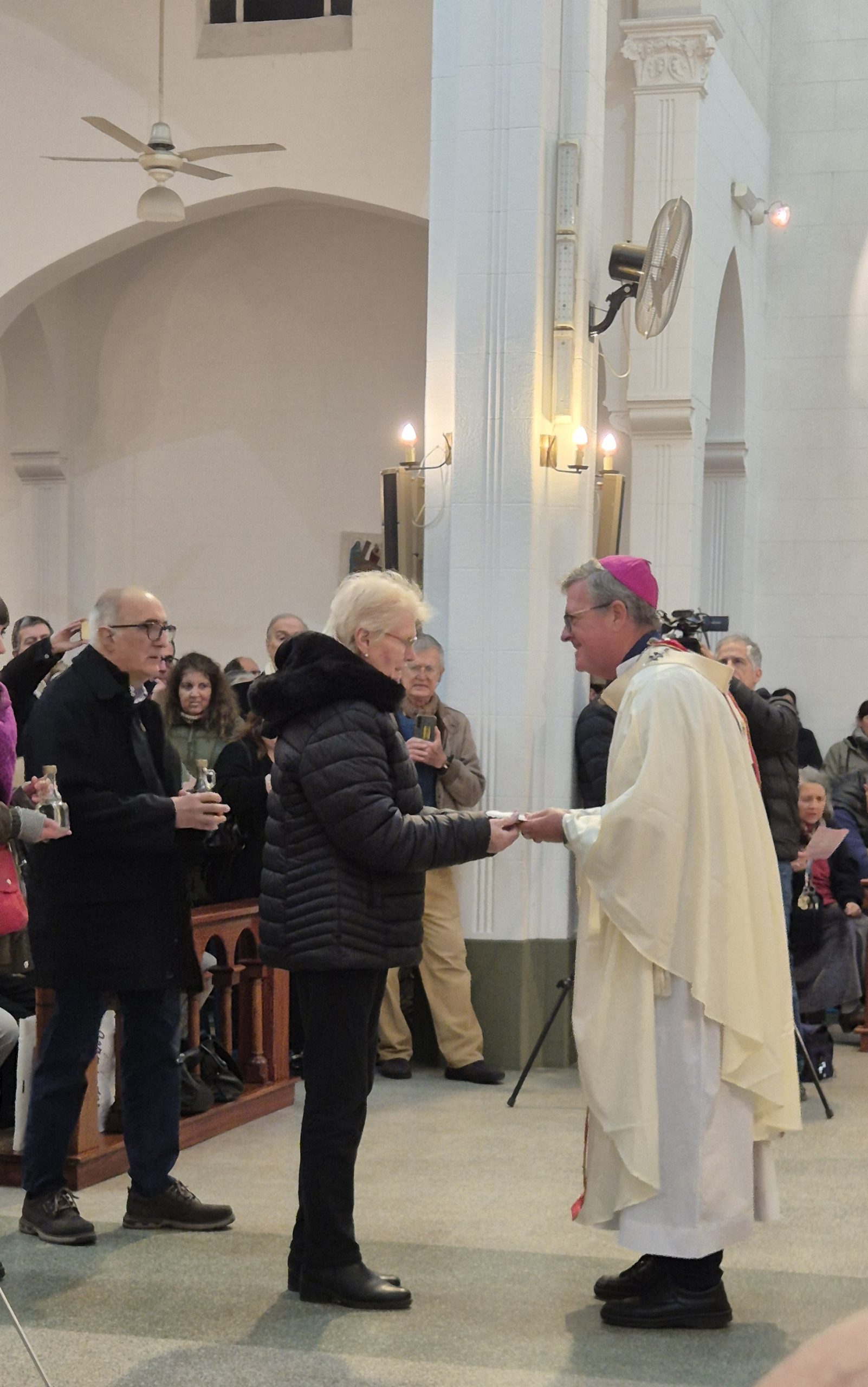
Amid the disorder left in his room after the crime, the final homily of Father Pedro Dufau was found, written for the morning Mass of that tragic 4 July 1976. In it he said: If God constantly speaks in the history of peoples and of every person, it is no less true that we all know how to find ways not to listen to Him.
And on this anniversary that squeezes our soul, the liturgy—which is never accidental—offers us these words of Jesus in the Gospel of Matthew: “Come to me, all you who are afflicted and burdened, and I will give you rest.” (Mt 11:28). And we want to hear them, and we want to reflect on them, and we want to pray them, and we want to live them.
In 1976 the burden was fear, persecution, imposed silence. The Palottines were burdened, yes, but not by discouragement; rather, by the weight of their people’s suffering. And so they chose not to look the other way; they decided to carry the afflictions of an Argentina that was bleeding out.
Their “crime” was preaching the Gospel out of season, defending life and human dignity. The red carpet stained with blood reminds us of the cost of that fidelity. Five lives—three priests and two seminarians—whose offering was “interrupted” that July night by hatred and blind violence. And it was not the death of isolated individuals; it was the testimony of a community, of a fraternity that disturbed the ruling powers because it lived the Gospel without anesthesia. We will always remember the words of then‑Cardinal Bergoglio: “They lived together and they died together.”
Half a century of a wound that continues to ache in the body of our Church and in the heart of the Belgrano neighborhood. We do not want to make a cold exercise of historical memory, but rather a living memory, because fifty years later, the burden sometimes disguises itself as impunity, forgetfulness, or a society that seems to have lost the capacity to be moved by another’s suffering. Pope Leo XIV says: in a world where the poor are increasingly numerous, paradoxically we also see certain elites of the rich growing, living in a very comfortable and luxurious bubble, almost in another world compared to ordinary people. This means that a culture still persists—sometimes well disguised—that discards others without even noticing, and tolerates with indifference that millions die of hunger or survive in conditions unworthy of human beings.
Then Jesus says in the Gospel: “And I will give you rest.” (Mt 11:28)
The five Palottines understood that true relief is not the indifference of someone who shuts himself away to watch reality through the media; because the relief Jesus promises is experienced when, even tired, we give our lives for a cause greater than ourselves. Alfredo Leaden, Pedro Dufau, Alfredo Kelly, Salvador Barbeito, and Emilio Barletti found their relief in the arms of the Father, being witnesses of peace and justice, coherent in their self‑giving until the end.
And we—where do we seek relief? Where do we seek relief from our own burdens? Perhaps in the divide that separates us, gathering only with those who confirm what we already believe and reassure us in our ideas? Or perhaps in the individualism that isolates us and calms us artificially in the face of the cry of those who suffer?
The blood of these five witnesses of the faith cries out to us that the only fruitful relief is born of reconciliation founded on truth and justice. There is no rest for a society if it does not heal the wounds of the past with God’s gaze. We cannot remain with arms crossed, crying over the past. Let the pain become prophecy, because their testimony shows that good does not progress automatically; it requires perseverance, memory, and a conversion that makes us capable of beginning again even after defeats.
And in the first reading of today’s Mass, God, through the prophet Zechariah, speaks to us again and announces: “Rejoice greatly, daughter of Zion! Shout for joy, daughter of Jerusalem! Look, your King is coming to you; he is just and victorious, humble and riding on a donkey.” (Zech 9:9) What a paradox! In a world obsessed with war, with the power of the strongest, with imposing ideas through fear and weapons, God presents us with a disarmed King. Verse 10 is blunt: “He will suppress the chariots of Ephraim and the horses of Jerusalem; the bow of war will be broken, and he will proclaim peace to the nations.” (Zech 9:10)
Fathers Alfredo, Pedro, Alfi, and the young seminarians Salvador and Emilio understood this prophecy perfectly; they did not believe in the messianism of weapons, violence, or oppression. They believed in the King who presents himself humble. Their only weapon was the Gospel; their trench was the parish, the neighborhood, the confessional, the altar, and closeness to the poorest.
And I return to Father Dufau’s final homily, the one that was never delivered but today resounds among us. Near the end he says: “Let us not be deaf to the Word of God. Let us not imitate the behavior of those who like to hear a word that adapts to their way of thinking and their way of being, a word that does not commit them to anything.” The Word we hear today commits us, challenges us, enlightens us; our burden also wants to be the burden of our people—the burden of unemployment, the affliction of poverty, the pain of the sick, the loneliness of our elders, the suffering of those exposed to the elements on the streets of the city. We do not want to be indifferent; we do not want cruelty and individualism to win.
Like these five witnesses of the faith whom we remember today, we want to commit ourselves to building a more just and more fraternal country. And as the first reading tells us, we want to do so along the paths of peace and nonviolence, following in the footsteps of Christ, announcing the Good News of the Kingdom of God. Because, as the beloved and remembered Pope Francis said: the Church needs all of us to be prophets—that is, people of hope, always direct, capable of speaking strong words to the people when they must be spoken, and of weeping together when necessary.
Today we weep together, but like the blood shed fifty years ago, our tears want to be fruitful and water the soil of a Nation that continues to cry out for justice.
Monsignor Jorge Ignacio García Cuerva Archbishop of Buenos Aires
4 July 2026