From Buenos Aires to Rome and now to Ireland

Status

Greetings from The Pampas from a Pallottine Father  who has spent 42 years ministering in parishes in Argentina which has been served by that order since 1929, where  Spanish is the spoken language.

I would love to join the Argentinian families who will attend the World Meeting of Families in Ireland this week but will not be able to travel. My fellow priest Fr. Johnny Sweeney will be in Dublin to assist at Mass with Pope Francis from Argentina. (Fr. Sweeney is from Doon and came here 3 years ago and is happy to be here).

On the day of his consecration as Bishop he came across as dour and distant but it wasn’t long before I changed my mind about my first impression of him. When he came to preside at a Confirmation Mass he declined the offer of transport and opted to come under his own steam firstly by train and then by bus No. 76. He recalled many visits to St Patrick’s Parish, one of the 200 parishes in the 11 million packed Capitol of the Pampas. His most poignant memory was of the funeral Mass for the 5 Pallottines  who were killed by the military on the 4/7/1976.He had been Spiritual Director to Fr. Alfie Kelly one of the slain whose grandparents emigrated to Argentina from Westmeath . At a Mass to commemorate those who died he said “That the parish had been blessed by the lifestyle of those who lived together and died side by side. I got to know them through Fr. Alfie who had a kind and generous heart”.

Buenos Aires has over 200 parishes and 1000 priests but Bishop Bergoglio knew each one of them by their first name and was a regular visitor to every parish, prison and homes for the elderly and under-privileged.  On Holy Thursday he would visit the prison in Villa Devoto and wash the feet of 12 inmates and then join them for Mate-a herbal tea traditional to Argentina.

His free time was spent visiting the priests and the sick who were housebound browse in bookshops, walk Avenida de Mayo  and enjoy 2 portions of pizza and a glass of wine on his way home, these meagre indulgences he missed, ‘being away from his dear Buenos Aires’- as he mentioned in a recent interview.

He was the superior of The Jesuit order in Argentina and a teacher. Before his appointment as Bishop he gave retreats. He is highly respected by his fellow bishops in Argentina and South America He was selected to prepare the final document with other Bishops at the Latin American and Caribbean bishops Conference held in Brazil from  13- 31 of May 2007. Brazil alone has 261 dioceses and over 400 catholic bishops.  This handbook is used for Catholic teaching and pastoral activity in the church. He also had a very positive relationship with other creeds based on dialogue and praying together in public. Pope Francis and Rabbi Abraham Skorka co-wrote a book on Judaism and Roman Catholicism. He travelled to Malmo, Sweden on 31/10/2016 to commemorate the 500th anniversary of Luther’s protest at Wittenberg in 1517. Speaking in Spanish he mentioned two positive consequences of the Reformation. He said “While separation has led to suffering and misunderstanding it has also led us to recognise honestly that without Jesus we can do nothing and it has enabled us to understand better aspects of our faith” and also “helped give greater certainty to Sacred Scripture in the Churches life”, he said.

He participated in the annual Week of Prayer for Christian Unity in Buenos Aires and was quite close to some of the Pastors in particular the Anglican Pastor of St. Saviours Parish, Rev. Charlie Halperin who retired at 75 and was placed in a nursing home by his Anglican community. Cardinal Bergoglio visited him and sensing Charlie’s unhappiness in his new abode transferred him to the home for retired priests in Buenos Aires where he lived happily with the other priests. This he did with the blessing of the Anglican Community. Sadly Charlie didn’t live to see his friend and Good Samaritan elected Pope on the 13/3/2013.


In 2010 Fr. Jacob Nampudakam S.C.A invited Cardinal Jorge Bergoglio to visit him at the Pallottine Head house in Rome and he accepted and joined the community for Mass and Supper and in turn invited Jacob to visit him when he came on Pastoral visitation to the 10 Pallottine Communities in Argentina. So in 2011 Fr. Jacob arrived in Buenos Aires and requested a visit to the cardinal and he acceded to his wish and I went with him. On leaving him he accompanied us to the street below, showed us some of the sights of Plaza de Mayo, thanked us for visiting him and bade us “Adios”. Jacob mentioned that it was the first time that a bishop (and he visit`s over 20 every year as superior of the Order) had accompanied him to his car on leaving The Curia.

On the 30/12/2004 194 people died and over 300 were injured in a fierce fire that took place in Republica Cromagnon dance hall in the centre of Buenos Aires. He met with their family members and supported their cause and fight for justice. If he couldn’t meet them in person he ensured that an auxiliary Bishop met them in his name. Thanks to his support and encouragement those responsible were imprisoned and the families got some compensation.

The humility of the man and his lack of value on worldly goods is demonstrated by his silver episcopal ring and his well-worn old black shoes-the latter he requested to be sent to Rome from his bedroom in Argentina. When requested by a bishop to appoint 12 monsignors for a particular diocese he refused saying that “All priests should be treated equally”.

On his birthday he shares breakfast with a group of homeless people and they are invited to stay on and cut the birthday cake with him. He has made sure that those who live rough in the area are provided with proper toilets and hygiene facilities giving these unfortunate people proper dignity.

His kindness to a Swiss Guard further demonstrates his humanity. Noticing that the guard was in a state of collapse he provided him with a chair. When the guard protested that he was on duty and couldn’t accept the help the Pope assured him that he would make thing okay with his boss. On another occasion noticing a guard who hadn’t eaten for a time he personally provided him with a sandwich.

I set out to provide a pen picture of a much beloved Pope Francis, his humility, his humanity, his kindness, his generosity and his strong faith, I hope I have succeeded. Without a doubt since being elected he has not changed his lifestyle but has shown a humbler, less formal approach to his office than his predecessors-a warm style that has been referred to as “no frills”. His common touch and insistence that the church be more open and welcoming has quickly endeared him not only to Roman Catholics but to millions of others around the world.

Fr. Tom O’Donnell, SAC,

Mercedes (B).

ORDINATION OF FR. JOHN REGAN SAC

Status

Fr John Regan giving a blessing to Archbishop Michael Neary at his Ordination in St Mary’s Church on sunday last. Pic Conor McKeown


HOMILY FOR THE ORDINATION OF REV JOHN REGAN
SUNDAY, 24TH JUNE, 2018.
St. Mary’s Church, Westport, Co. Mayo


I welcome you all as we come to celebrate this special day in the life of John Regan and his family and the life of the Pallottine Order and the life of the people of John’s parish of Kilmeena and Westport. Welcome to the Provincial, Fr. Derry Murphy, the Director of Formation, Fr. Michael Irwin and the members of the Pallottine family, to Canon James Walsh, the priest in Kilmeena, to Charlie McDonnell, the Administrator and Fr. Patrick Burke, C.C., the people, religious and priests of the area. Welcome to John’s colleagues and staff members from St. Patrick’s College, Maynooth.

As we come to celebrate the Ordination of Reverend John Regan we thank God for the Society of the Catholic Apostolate, better known as the Pallottines, founded by St. Vincent Pallotti in 1835. The aim of this Society is to increase the collaboration among the faithful of the Church, that is among the Diocesan Priests, the male and female religious and the laity, to fulfil fully and more efficiently the apostolic tasks. The Founder St. Vincent was especially marked by the deep desire to revive faith, to rekindle charity as he worked with rich and poor alike. He taught that every human-being is a mirror of God, worthy of reverence and love. He also proclaimed that the role of each Christian is to be a sacrament of Christ’s presence in the world. Today we realise how relevant and how urgent that message of St. Vincent is for Ireland today. I had the privilege 20 years ago of ordaining another priest for the Pallottine Order, Fr. Brendan Walsh in Partry, Co. Mayo.

On the day John Regan was brought by his parents the late Michael and Annie to the Church to be baptised, did the question which surrounded John the Baptist in today’s Gospel, run through their minds “what will this child turn out to be”? And St. Luke continues “and indeed the hand of the Lord was with him”. Today the Lord is with John Regan in a very special way and promises to accompany him and to direct his priestly ministry.

On this Feast of John the Baptist we realise that John the Baptist’s vocation was to point out the saviour and that vocation must be relived by each one of us. Today the Lord anoints John Regan to take on a special role in discipleship as he points to the Lord and encourages others to become disciples of Jesus Christ.

John assumes this new responsibility at a time of rapid change in our country and in our church. The sociological props which were there in support of faith in the past are being belted away one by one. This can impinge on people of faith in general and on priests and on future priests in particular in two ways. On the one hand there is the temptation to accommodate and compromise in our faith and its implications for lifestyle. On the other hand it is an opportunity for us to deepen our faith and respond in a courageous way as we cope with the challenges of a culture which at times is endeavouring to behave as if God did not exist.

Ours is a time for deepening of faith and responding with courage. In his exercise of priestly ministry John will return time and again to the words of the risen Lord to his disciples in the Gospel of Matthew: “go make disciples of all nations, baptising them in the name of the Father, and of the Holy Spirit; teaching them to observe all that I have commanded you; and behold, I am with you always, to the close of the age”. As John sets about making disciples for Jesus Christ he will always acknowledge the responsibility of being a disciple in his own life and he will never require of others what he has not first demanded of himself. He will use his human qualities, his interests, his priestly training and technological resources in making disciples. He will do so with courage but also with an understanding of and making allowances for human frailty. He will sustain the people of God by the sacraments of Jesus Christ, baptising and welcoming new members into God’s family, sustaining them with the Eucharist and the word of God. He will forgive sins not yet committed, bless their married love, he will have responsibility for introducing them to Jesus Christ. Realising that they will not be able to maintain their relationship with Jesus Christ if they are only fed a diet of secular philosophy he will endeavour to teach them the ways of Jesus Christ and enable them to appreciate the beauty of Christ’s gospel.

All of this may at times appear to be counter-cultural and a huge challenge and yet John has to realise that he is dependent on and a vehicle of Jesus Christ himself who reminds us in those final words to his disciples. “Behold I am with you always to the end of time”. John will exercise his priestly ministry in close co-operation with his brother priests and with the people of God whom he serves. Like John the Baptist he will always realise that he must point away from himself towards Jesus Christ: “he must increase, but I must decrease”.

On this joyful occasion I congratulate Fr. John on his ordination to the priesthood, his family, his neighbourhood, Fr. Derry Murphy, the Pallottine Fathers, the people and priests of Kilmeena and Westport and those who contributed to his formation. We pray that through John’s ordination today others will be encouraged to give some consideration to priesthood and the importance of supporting priests in their ministry.

Your prayers have been a hugely significant contribution in bringing Fr. John to this day. Could I encourage you to continue to keep Fr. John and all priests in your prayers. We will be faithful to God and generous in our serving of the people of God.

Archbishop Michael Neary, DD,
Archbishop of Tuam.


Fr John Regan from Carrowholly Westport after his ordination ceremony at St Mary’s Church Westport on sunday last. Pic Conor McKeown


PALLOTTINE ORDINATIONS NAIROBI 2018

Status

Reflection based on the Homily of Archbishop Martin Kivuva,
Saturday 23rd June 2018, at St Joseph the Worker Parish, Kangemi, Nairobi.

As the day was filled with joy, the parish of St Joseph the Worker, Kangemi, started filling up from the early morning hours. The gathering included people from different corners of Kenya, and moreover from Tanzania, Uganda, the USA, Austria and Germany, who all came to witness 5 Jesuits and 3 Pallottines being ordained to the priesthood by Rt. Rev. Martin Kivuva, the Archbishop of the Archdiocese of Mombasa. Our very own Pallottines were: Rev. Frs. David Kakinda SAC, Ronald Kyomya SAC and Stephen Muli SAC.

His grace Martin, reminding the entire congregation of that day when His Holiness Pope Francis visited the church of Kangemi, revived in people’s hearts the joy and fulfillment that November 27th 2015 brought. But this being another function with a different spiritual experience, in his homily, the prelate reflecting on the call of Jeremiah (1st Reading Jer 1:1,4-10), he invited everyone to meditate on vocation as a gift. It is a gift given to a person, taking in the true nature of the person, his strengths and weaknesses. As God shares that grace of a deep call, He shares too the grace to live the same call and the nurturing of it to fulfil its divine role among God’s people. Jeremiah lamented a lot about the call itself, but he lived well his ministry because ‘God was with him.’ Our families too have a huge role to play in how one responds to that divine whisper in our hearts. Any failure of any family to live it’s commitment of upholding family values, recalling the words of Pope Francis, leads to the dwindling of the priestly vocation and a falling apart of our Christian families.

For the newly ordained priests promoting family values is a way of continuing the divine call and the Church’s mission. They are now becoming elders (2nd Reading, 1Pt 5:1-5) who need to grasp and articulate the needs and challenges of the communities they will be serving. They are to become not only a gift but also exemplary ministers and role models. They are to become people who care as Jesus the Good Shepherd did for his flock.
This will become effective through wearing the shoes of the 72 disciples (the Gospel Reading, Lk 10:1-9) who were sent two by two as representatives of the good Master. The capacity to articulate, relying on the grace of ordination, equips them with beautiful and amazing capacities for taking care of the plentiful harvest. This is where the healing capacities will be seen. We need to heal our societies from corruption, mistrust and wars by being instruments of peace, sharing the values of a just society, influencing good causes. “It all starts with you, it starts from where you are.”

As we all carry a responsibility in the priesthood of the People of God, each one of us has a special mission of praying and assisting the newly ordained priests to live well their vocation. We need to be people who inspire them to grow in priestly values, to continue saying ‘yes’ to their Master and Lord, to fully commit themselves to serve and becoming a gift that continues to have that goodness.

Bishop Martin Kivuva reminded them and each one of us of the four pillars that will continue making us mature in Christian and priestly values: (a)we need to love the sacramental life as we are graced by the reception of the sacraments and animated to pursue true Christian living; (b) we need to love prayer life as it is the oil of our spirituality; (c) we need to live a charitable life by imitating our Saviour as that is our deepest call; and lastly (d) we need to love God’s Word, it nourishes and instills the divine values in us.

Before concluding the Holy Mass, his grace Martin Kivuva read what was good news for the church in Kenya, i.e. that the Holy Father has appointed Bishop Norman King’oo to lead the Machakos Diocese. He has been transferred from Bungoma Diocese to Machakos. Machakos is the Diocese of our newly ordained Pallottine, Fr. Stephen Muli SAC.

Congratulations to you, our newly ordained Pallottines, may the good Lord grant you the grace to live well your call and flourish well in the vineyard of the Lord.

Fr. Emmanuel Msuri, SAC,
Nairobi.


Homily for the Feast of Queen of Apostles at Knock by Rev. John Regan SAC

Status

19th May 2018,
Knock,
Co. Mayo.

A sincere welcome to you all present here in Knock today, to all who travelled from our parishes of Corduff, Shankill and Thurles, to all our friends. We gather in a spirit of prayer, to mark our annual celebration of Mary Queen of Apostles, our patroness. It is a great honour for me personally to be here with you as a deacon as I prepare for my ordination to the priesthood on the 24th of June. Please keep me in your prayers. This year is especially important for our Pallottine family worldwide as it is the Bi-centenary of the ordination to the priesthood of our founder Vincent Pallotti.

We are here today, to celebrate Mary Queen of Apostles, devotion to Mary was very important for our founder Vincent, we know of that deep personal love that Pallotti had for his most beloved mother Mary, it was this personal love and the role of Mary in the Apostolate that prompted Pallotti to give Mary as patroness, intercessor, Model and Teacher to the members of the Society of the Catholic Apostolate.

From the beginning he placed the Society under the protection of Mary Queen of Apostles, he dedicated the Society to her telling his followers “that one who truly loves Mary, will not only be saved, but, through her intercession, will also increase in holiness day by day until they become a great saint.

Why has our Lady received the title Queen of the Apostles? What defines an apostle of Jesus Christ is the openness to co-operate with the working of the Holy Spirit in one’s life and as Vincent Pallotti claimed, no one not even the apostles co-operated more than Mary with the Holy Spirit.

We see Mary’s complete surrender to God’s will in becoming the Mother of the Saviour of the world. As Pope John Paul put it, ‘Mary was the first Tabernacle’, what a lovely title. It was through her sacred womb that God chose as the gateway to reveal to humanity the unconditional, infinite, immense love that he has for each one of us. A crisis pregnancy, a single mother, confusion, uncertainty, Mary’s ‘YES’ changed the world.

Mother behold thy son; Son behold thy mother. At the foot of the cross Jesus is entrusting all of humanity to Mary’s motherly care. She was the first person to hear Jesus’s cry ‘I THIRST’ Our Lady knew how deep is his longing and thirsting for all his children. Her whole life was about presenting Jesus to others, helping us all to get closer to her son.

Isn’t there something about mothers?, they know how to diffuse a situation, how to make light of things. I know when I was young, if I had any problem, I would chose to go to my mother. There’s a softness in mothers, mothers have a way of sorting out problems with gentleness and love and so too with Our Lady, she is the most tender and loving mother who keeps a watchful eye on all her children and points them to the way of her son.

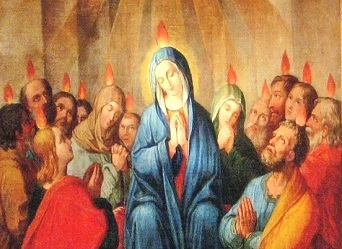
In the picture brought up at the beginning of Mass, Mary is at the centre praying with the Apostles for the Holy Spirit to come. We pray today that we will stand up fearlessly in defending the gift of life over the coming week and that we will be filled with the conviction and courage the Apostles received at Pentecost.

The Holy Spirit is truth. The Holy Spirit does not lie. There is no confusion, no error, no grey area with the Holy Spirit, as it is the spirit of the Almighty God. That’s why we need to pray much to the Holy Spirit, for discerning minds and proper judgement in a sometimes erring and deceiving world. St Louis Marie de Montfort tells us when someone has devotion to our Blessed Mother the Holy Spirit flies to that soul and makes its home there. The Holy Spirit and Our Lady are inseparable. Stay close to our Blessed Mother and pray much to the Holy Spirit.

‘Come Holy Spirit, come by means of the powerful intercession of the immaculate heart of Mary your well beloved spouse.

Rev. John Regan, SAC.


MARY QUEEN OF APOSTLES – 2018

Status

Mary Queen of Apostles

As followers of your son Jesus we
commit ourselves to re-awaken faith
and enkindle charity both in our own lives
and in the lives of others.
Trusting in you, Holy Mother,
we have every confidence
with the aid of your intercession;
and we direct our powers of body and
spirit to the greater glory of God.
Following the example of St Vincent Pallotti,
we ask your help to deepen our prayer
for the growth of the Kingdom;
and finally, we hope, together with you,
to enjoy the fulfilment of paradise forever.
Amen.


​Happy Feast Day to one and all.

Derry.

PALLOTTINE PILGRIMAGE TO KNOCK 2018

Status

Hi to you all. As you can see from the following taken from the website of the Knock Shrine, the refurbished chapel in Knock opens tomorrow and we will have our annual Mass there on Saturday at 15.05.
It will be live streamed and you can follow it on the link given.

United in prayer as we celebrate our Feast Day with Mary, our Mother and Patroness.

God bless

Derry.

Parish Church & Shrine open Friday 18 May

Friends of Knock Shrine will be delighted to learn that Knock Parish Church and Apparition Chapel are set to reopen this Friday 18 May following extensive refurbishment.

The first public Mass will take place the following day, Saturday 19th at 9am and all parishioners and friends are invited to attend this first special celebration with Fr Richard Gibbons. This will be the first Mass to be celebrated in the Church since its closure last October.

The Parish Church has a special place in the hearts of many. Its prayerful, peaceful atmosphere makes it not only the oldest, but also one of the most important places in Knock for parishioners and pilgrims alike. It is here that the 15 witnesses worshipped at Mass and where many of the early pilgrims to Knock gathered in throngs to pray and to see the sacred site of the Apparition.

All of the beautiful historic features, windows, stained glass windows and altars have been professionally cleaned and restored, including the Stations of the Cross which have been in place since circa 1900. New seating. lighting and floors have been added to both chapels.

The renovation also included technological upgrades to allow for live streaming of Masses each day from both the Parish Church and the Apparition Chapel.

Fr Richard would like to say a special thank you to the parishioners of Knock and visitors for their patience and understanding over the past few months. We look forward to welcoming friends into the newly renovated churches and hope that people will be able to join us for that fist special Mass on Saturday.

MASS TIMES

SATURDAY 19 MAY
9am Parish Church
(live stream available on WATCH page)
3.05pm (Pallotine Pilgrimage) Parish Church
(live stream available on WATCH page)
3pm Basilica
7.30pm Parish Church
(live stream available on WATCH page)

Cardinal Louis-Marie Ling Mangkhanekhoun, the Cardinal Titular of the Basilica of San Silvestro

Status

San Silvestro, Rome

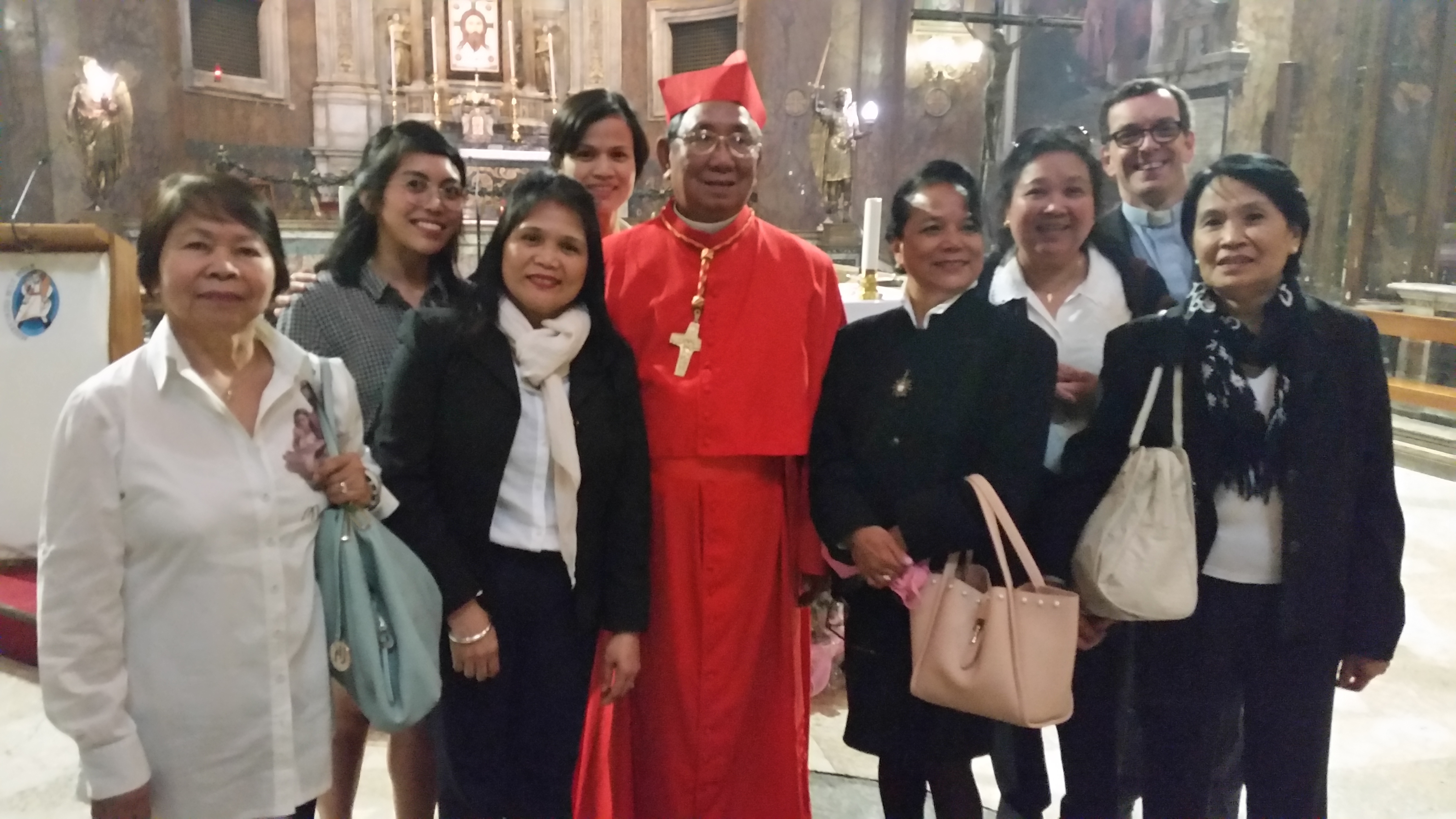
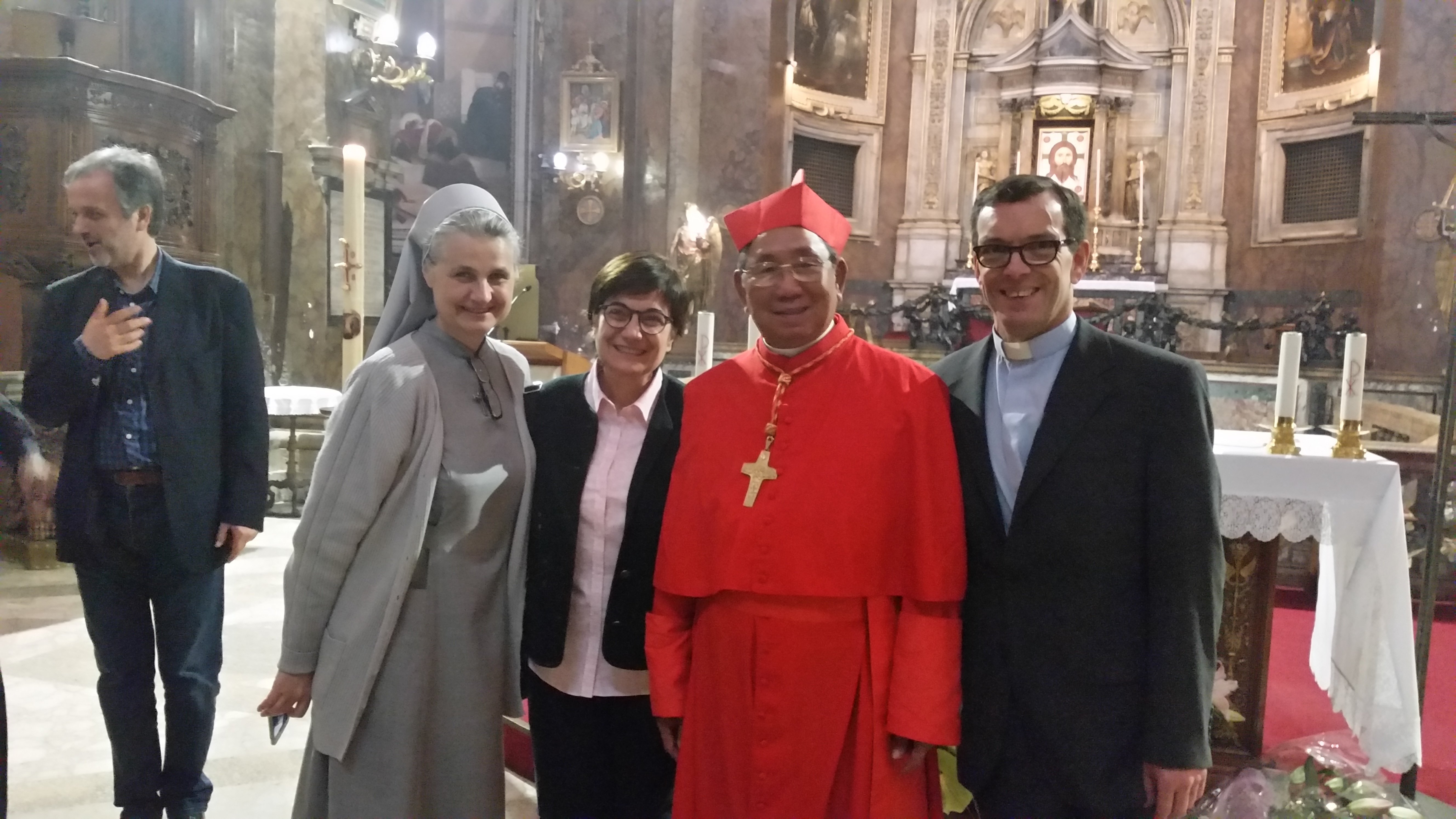
Cardinal Louis-Marie Ling Mangkhanekhoun, the Cardinal Titular of the Basilica of San Silvestro formally took possession of the Basilica on Sunday 22 of April. John Fitzpatrick, the Rector, and Rory Hanly, the vice-rector, organized the ceremony together with Msgr Vincenzo Peroni, the Papal Cerimoniere, or Master of Ceremonies. The initial part of the ceremony took place at the entrance to the basilica and then continued with concelebrated Mass at which the Cardinal was the main celebrant and homilist. In his words of welcome John spoke of the long tradition of appointing a Cardinal titular to the church, the first such appointment was made in 1517, and he remembered fondly the last Cardinal Titular, the late Cardinal Desmond Connell who died in February 2017.
Cardinal Ling is from Laos and the first Cardinal from that country in Asia. He was baptised in 1952. He entered the Institute Voluntas Dei, which was founded in Canada in 1958 by Fr Louis Marie Parent, O.M.I. It is a Secular Institute of Pontifical Right, and the first mission of the Institute was to Laos. He received his formation in Edmonton, Canada, and was ordained a priest in a hurried ceremony in a refugee camp on 5 November 1972 for the Apostolic Vicariate of Vientiane; he spent the years 1984 to 1987 in prison. He was appointed Apostolic Vicar of Pakse by Pope John Paul II in 2000, and coincidentally was ordained Bishop of 22 April 2001.

His cousin, Luc Sy, was a married catechist, and was martyred in 1970; the decree of martyrdom was issued by Pope Francis in June 2016 and he was beatified on 11 December 2017.

Martyrdom has marked the life and ministry of Cardinal Ling, he was present when two companions were martyred.

Cardinal Ling was accompanied by his secretary, Fr Lu, and by Fr Roland Jacques, OMI, who ministers in Vietnam, and Fr Thomas Klosterkamp, Postulator General of the OMI. The community at San Silvestro invited the Rector General, Fr Jacob Nampudakam, the Rector of the Irish College, Msgr Kieran O’Carroll, other priests from the communities in Rome and friends of the San Silvestro community. The members of the General Coordination Council of the Union which was meeting in Rome that week, also participated. The Mass was solemn, yet joyful, prayerful and celebratory and the Link Community choir animated the liturgy with great passion, and students from the Irish College together with Wilhelm, of the Canons Regular of St Augustine, were the acolytes and altar servers. All those present took part in refreshments in the courtyard and Cardinal Ling mixed with everybody and very willingly posed for photographs.

The Cardinal impressed everybody with his personal warmth, simplicity and openness. Congratulations to John and Rory and all at San Silvestro who did so much to make it a memorable occasion.

Fr. Derry

FR. GEORGE DAMBALL SAC R.I.P.

Status

MAY 2, 2018

Fr. George Damball died in KCMC Hospital, Moshi, Tanzania, during the night. May his good soul rest in peace.

He was born on 5 December 1946, he made his first Pallottine Consecration on 12 September 1968 and was ordained to the priesthood on 1 July 1973. George was born at Oldonyo Sambu, Arusha and baptised at St Therese Church, Arusha on 15 December 1946. He made his First Communion in Tlawi and was confirmed in Karatu which was home to him then. He was invited to become a Pallottine by the late Fr John Costigan. He came to Ireland for Novitiate at St Marys, Cabra in 1966 and then studied Philosophy at St Patrick’s College, Thurles and also 1st year of Theology. He returned to Tanzania and did the remainder of his Theological studies at Kipalapala Seminary in Tabora.
He was appointed to Endabash after ordination; from 1975-76 he did an MA in Theology at Maryknoll Seminary, New York and from 1977 to ’79 was Spiritual Director and Professor of Spiritual Theology at Kipalapala Seminary. Following some studies in Pallottine spirituality in Rome he was appointed novice master for Tanzanian novices in Kigali, Rwanda. He later ministered in the area of formation with the students in the East African delegature both in Tanzania and later in the house of studies at Ngong Road, Nairobi, and remained a guide for many of our students throughout his life. Fr George worked at Dareda Parish, in Gallapo, Bashnet, in Magugu at two different periods, and at Sacred Heart Parish, Nairobi.
An apostolate which was very close to George’s heart was that of the AA or Alcoholics Anonymous, he officially started to collaborate with AMECEA in 1995 and he accompanied many persons who were going through the 12 Step Programme from then on, he did this wherever he was based. In 2001 the Religious Superiors Association of Tanzania requested his services to work in a team set up to run a new AA Centre in Dar-es-Salaam and he later took up this post and served as Assistant Director of a Rehabilitation Centre set up by the Capuchin Fathers in Dar and remained in this post for 2 years. From 2008 up to the final year of his life Fr George was a visiting staff member at a rehabilitation facility in the Lutheran Hospital in Haydom; he would travel there and spend a few days giving seminars in every six week cycle and often went above and beyond the call of duty in accompanying individual patients in their path to recovery. It was also his dream to set up a facility or a half-way house where recovering alcoholics could learn new skills in order to cope with life in their own communities and had plans for such a facility in Makiungu.
George was appointed assistant priest in Makiungu on 1st August 2012 and spent the remainder of his life as a priest there, he ministered faithfully to the local community and was also zealous in cooperating with personnel of Makiungu Hospital in strategies to combat the excessive use of alcohol in the local area.
George suffered set-backs in his health from the middle of 2017 onwards, it started with a blood clot in his leg and a general sense of weakness. He spent a good deal of the rest of the year in the community in Njiro with visits to Nairobi to seek medical attention. He suffered a stroke while staying at the formation house in Nairobi on March 4, he was hospitalized in the Mater Hospital, Nairobi; the stroke was diagnosed as a relatively mild one and it was expected that he would recover full strength and mobility with intensive physiotherapy. However, while in the Mater he was diagnosed with stomach cancer; initially it was hoped that he would have surgery and chemotherapy but his general condition precluded surgery. At the request of his family he was transferred to KCMC Hospital in Moshi, Tanzania, by the flying doctor service. He was administered chemotherapy but it was suspended after a few sessions as he was considered too weak to support it. He died peacefully at 21.45 on 2 May in the ICU at KCMC.
Fr George’s family requested that his funeral take place the following week in order to allow time for his nephew to travel from France for the funeral. His remains were removed from KCMC on 8 May and taken to St Vincent Pallotti Parish, Esso, Arusha, for Mass with members of his family present. From Esso he was taken to Gallapo where an all-night vigil of prayer took place. The concelebrated funeral Mass was on Wednesday 9 May, the principal celebrant was Archbishop Isaac Amani, Archbishop of Arusha, and Apostolic Administrator of Mbulu, Bishop Edward Mapunda of Singida Diocese concelebrated along with our Pallottine confreres and many other priests. Fr George was laid to rest in the Pallottine Cemetery in Gallapo. May he rest in peace.


The following is a translation of the homily preached by Archbishop Amani, kindly translated by Martin Mareja.
“1Peter 4: 7-11; Matthew 11.25-30. My dear brethren, We are gathered here to pay our final respects to Fr George Damball, RIP and to entrust his soul to God his Creator. I wish to express my deepest sympathy to the members of his family, the Pallottine leadership team and to all the members of the Society. May God grant Fr George Damball eternal rest. In order to understand events that happen in our lives we need to contextualise them in the bigger picture of our life in its totality. You might ask what I mean by that. Our Christian faith tells us that a human person passes through five phases or stages in his or her life.
Stage number one is that God wills us to be. We read in Jeremiah 1, 5, “Before I formed you in the womb I knew you; before you were born I set you apart, and I appointed you prophet to the nations”. This is the first stage of every human person, that God in his free will wants us to be.
Stage two is called conception. A child is formed in the mother’s womb. This is a very important phase in God’s plan for all human beings. Before a child is born he or she lives in the womb of the mother for nine months during which he or she is totally dependent on the mother. The mother nourishes and cares for it. That is why we must show love and respect to our parents.
Stage number three is the birth of a child. At birth a child enters into a different world from that of its mother’s womb and is introduced to a particular culture with all its traditions. It is in this stage we start to face the challenges of life; we meet different people and as we grow we begin to make choices such as a vocation to a certain life style. This is also a period of the discovery of our talents, strengths and weaknesses and with the help of God’s grace one learns to accept his or her true identity. Most of us knew Fr Damball at this stage, at a significant stage of his life.
The first reading in our liturgy today emphasise the fact that we are God’s creation and we have been endowed with talents and with the time to serve others. St Peter the Apostle reminds us that we are ambassadors of God’s talents. We must use them wisely. Fr George did the same. He used the talents which were God given for the service of others. He is a model for each one of us. The prophet Jeremiah knew and confessed that God called him to serve others. God has a plan for each one of us and it is in prayer that God reveals his plan for us.
The fourth stage is the death of a person. Just as birth brings us into this world, death takes away a human person from this world to another. Death is a mystery, it is God alone who knows when we will die. Death is a reality and we must be ready for it by leading always a good life. Fr Damball was very ill in the last few months of his life but he still trusted in the Lord’s healing hand. He hoped for a cure so that he could go back to continue with his apostolate, but the time arrived when God said “Come to me Fr Damball, you are weary and are carrying heavy burdens, and I will give you rest”. After his death he is now enjoying perfect peace with the Lord in heaven.
The fifth stage is life in heaven with the Father. Our faith teaches us that after death all persons will face the Just Judge. In the Gospel of Matthew 25:46, we read “And these will go to into eternal punishment, but the just to eternal life”. Jesus wants to convey a simple message that if we want to go to heaven then we must lead a good life. Fr George died at the age 72 years. And he was a priest for 44 years and 9 months.

GEORGE DAMBALL
  1. We thank God for the gift of Fr Damball. We pray that God in his mercy will grant him eternal happiness through the death and resurrection of our Lord Jesus Christ.
  2. We stand by the family members and friends who mourn the loss of Fr George. May the Lord comfort you. We promise you our prayers for the eternal rest of his soul.
  3. The Pallottine community has lost one its members. May God fill you with his peace and may he continue to call many more workers into his vineyard.
    Let us pray for each other and for the grace to continue to be good Christians full of zeal and enthusiasm and that we may remain credible witnesses of the Risen Lord in our daily lives. I invite you all to continue to reflect on the five stages of a Christian life which I shared with you: God has plan for you; God willed you to be; a Christian life is measured by the service you give to his people; remember that death is a reality; by leading a good life we will be ready always to meet our Just Judge.
    Eternal happiness grant unto him O Lord, and may perpetual light shine upon him. Amen.”

Prayer for the UAC General Coordination Council Meeting

Status

Prayer for the UAC General Coordination Council Meeting

April 21-25, 2018


Lord God, we pray for the annual meeting of the General Coordination Council. May it be a true experience of the Cenacle, of being united with You and with one another in the love and power of the Spirit of Jesus, Your Risen Son, sustained by the accompaniment of Our Lady Queen of Apostles, of St. Vincent Pallotti, of Blessed Elisabetta Sanna, Józef Stanek and Józef Jankowski.

Help us to grow in faithfulness to Jesus’ prayer that we be one, as He and You, Father, are one, and to live ever more generously his new commandment to love one another as He loves us.

We ask You to free us from any blindness, so that we may see and love each other with Your eyes and Your heart, as brothers and sisters, each created in the image and likeness of God and continually recreated in the image and likeness of God-with-us, Emmanuel, Jesus Christ Your Son.

Give us hearts capable of reading deeply the signs of the times concerning the Union at this point in its history, and of responding generously, courageously and creatively to the issues and concerns that our Pallottine Family is facing in its mission to be of true and humble service to the universal and local Church and beyond.

Grant us the spirit of discernment, so that all that we do may be guided by You, that our decisions may be the expression of nothing other than Your Will for the Union at this time for the building up of Your Kingdom in the Church and the wider world.

We ask this in the name of Jesus Christ, Your Son, in the power of the Holy Spirit, through the intercession of Mary, Queen of Apostles, and of St. Vincent Pallotti.

Amen.

“From Argentina to the Sanctuary of San Bartolomeo, dedicated to the martyrs, relics of the religious killed in 1976.”

Status

The Community of San Egidio has had a long standing friendship with the Pallottine community in Argentina, when the first members arrived there they were welcomed for a time in the community at San Patricio in Belgrano, Buenos Aires. The late Saint John Paul II entrusted the Basilica of San Bartolomeo on the Tiber Island in central Rome to the San Egidio Community. The Community requested the Pallottine Community in Argentina to provide them with a significant item to form part of the memorial to the new martyrs which is housed in the Basilica. Fr. Tom O’Donnell, SAC, received from Msgr Guillermo Leaden, SDB, brother of the late Fr. Alfredo Leaden, a chalice which belonged to him and was used by the community in Belgrano, and it was considered that this would be a significant contribution to the memorial. The chalice, together with a paten, and a purificator specially prepared by Sr. Magdalena of the San Antonio de Padua Community in Mercedes, Buenos Aires, and embroidered with 5 red crosses and the letters SAC, was solemnly placed on the altar dedicated to the Martyrs of the Americas in the Basilica on 2nd of February. Monsignor Vicente Ojea, Bishop of San Isidro, Argentina, and President of the Argentine Episcopal Conference, presided at the Prayer Service, he was accompanied by the Vice-president of the Conference, Msgr Marcelo Colombo, Bishop of La Rioja, the Rector General of the Society Fr. Jacob Nampudakam, SAC, Fr. Juan Sebastian Velasco, SAC, Postulator of the Cause, and other Pallottines resident in Rome.

The history of the Sanctuary of the new martyrs is the following: “In 1999, in preparation for the Jubilee Year 2000, Pope John Paul II instituted a “Commission of the New Martyrs” to investigate Christian martyrdom of the 20th Century. The commission worked for two years in the Basilica of San Bartolomeo and gathered almost 12,000 dossiers.

Andrea Riccardi, Founder of the San Egidio Community, introduced his work on more than 9,600 files in the archive and noted “I went into the large archive of the Commission of the New Martyrs where letters, reports and memoirs had arrived in Rome in the previous years from all parts of the world. I started to leaf through them. There were official letters from episcopal conferences from all over the world. There were also memoirs from simple groups of religious. As I read I became impassioned. There were thousands of stories of contemporary men and women, Christians who were killed because of what they were.”

After the Jubilee Year, Saint John Paul II wanted the Basilica to become the location of the Memorial of the New Martyrs. The proclamation was solemnly celebrated on October 12th 2002, in the presence of Cardinals Ruini, Kasper and George, and of Tesctist, the Orthodox Patriarch of Rumania; the large icon dedicated to the Witnesses of the Faith of the 20th century was placed on the high altar. On April 7th 2008, Pope Benedict XVI honoured the memory of the Witnesses of the Faith of the 20th and 21st centuries with a visit to the Community of San Egidio on its 40th anniversary. “The six altars in San Bartolomeo”, explained the Pope, “recall the Christians who fell under the totalitarian violence of Communism, of Nazism, those killed in America, Asia and Oceania, in Spain and Mexico, in Africa; we retrace ideally many painful events of the past century. Many of them fell while fulfilling the mission of the Church to evangelize; their blood was mixed with that of the native Christians to whom the faith was communicated.”

The website of the Basilica can be accessed at www.sanbartolomeo.org and the link to the Memorial can be founded there; it is also possible to take a virtual tour of the Basilica.